
A fragrance bottle does more than hold liquid. In many collections, it is also expected to attract attention, communicate style, and remain memorable on a retail shelf or dressing table. That is why decorative perfume bottle design continues to matter in fragrance packaging. Some brands prefer a minimal bottle, but others deliberately use ornament, texture, relief, color, or metallic detail to make the bottle itself part of the product experience.
For buyers and fragrance brands, the challenge is not simply choosing a beautiful bottle. A decorative design still needs to work as a practical glass package, with suitable structure, closure fit, filling compatibility, and repeatable production quality.
Decorative Perfume Bottle Design Begins With Visual Language
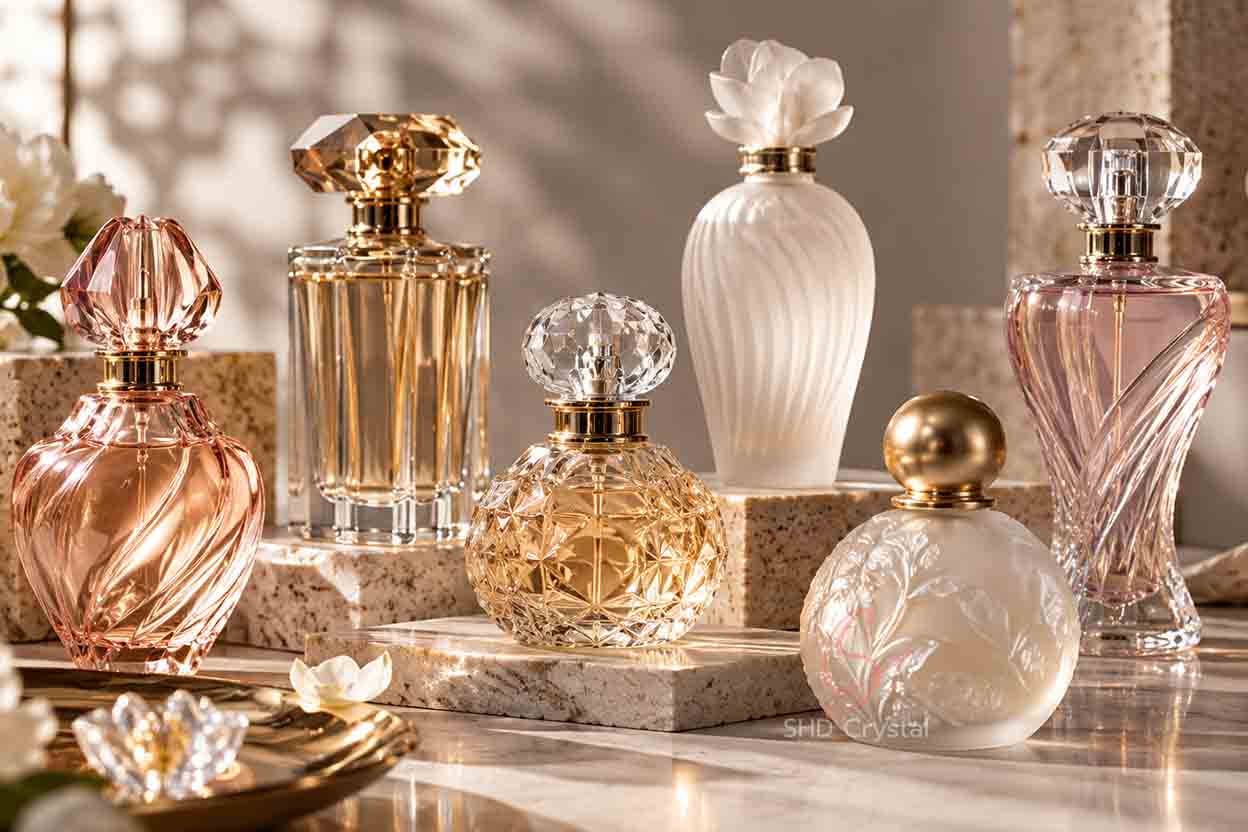
A decorative bottle usually attracts attention before the fragrance is even tested. This decorative effect may come from embossed patterns, faceted surfaces, sculpted shoulders, frosted finishes, colored coatings, engraved details, metallic accents, or unusually styled caps. Each element changes how the bottle reflects light and how it is perceived in the hand.
For ornamental glass perfume bottles, decoration often serves one of two purposes. It can create a more luxurious gift impression, or it can help the packaging stand out from simpler competitors. In both cases, the bottle is being asked to carry part of the brand identity.
Decoration Should Support the Product, Not Overwhelm It
A bottle can be richly decorated without becoming visually confusing. The most effective decorative designs usually have one clear direction. A floral relief may suit a romantic fragrance line. Geometric cutting may feel more modern. Soft frosted glass can create a quiet elegant effect, while gold accents or jewel-like caps may suggest a more gift-oriented presentation.
In custom fragrance packaging, this means the decorative style should be chosen to match the fragrance concept rather than added only for visual complexity. A common mistake is combining too many effects at once. Heavy embossing, sprayed color, metallic printing, and an elaborate cap can each be attractive on their own, but together they may make the bottle feel overworked.
Glass Shape and Decoration Need to Be Developed Together
Decoration is not only a surface decision. It also changes how the underlying bottle should be designed. Deep patterns, raised details, or strong faceting may influence wall distribution and mold release. Decorative surfaces can also affect how the bottle is inspected, how labels or logos are placed, and how light behaves across the finished glass. That is why decorative perfume bottle design should be reviewed as a complete structure rather than as a standard bottle with ornament added later. The body shape, shoulder transition, neck area, and base proportions all need to support the intended decorative treatment.
Ornamental Bottles Still Need Practical Function
A highly decorative bottle is still expected to perform like a normal perfume package. The bottle must stand securely, accept the spray pump correctly, work with the intended cap, and remain suitable for filling, storage, and transportation. Decorative elements should not interfere with these basics.
Interested in custom glassware or related products?
Contact our team to discuss your project requirements.
For ornamental glass perfume bottles, one practical concern is that decorative surfaces may make some flaws more visible rather than less. Uneven coating, inconsistent engraving, or slight dimensional differences can stand out more clearly on an ornate bottle than on a plain one. This is why production consistency matters so much in decorative packaging. One impressive sample is not enough if later batches lose sharpness, alignment, or surface quality.
Decorative Finishing Adds Value but Also Adds Process Steps
Many decorative perfume bottles are not defined by glass forming alone. Their final appearance often depends on secondary finishing. These processes may include frosting, color spraying, electroplated effects, hot stamping, engraving, printing, polishing, or decorative cap assembly. Each step adds visual value, but each also introduces another quality checkpoint.
For custom fragrance packaging, this means brands should consider not only the design effect, but also how the final bottle will be produced repeatedly. The more complex the finishing route, the more important it becomes to establish clear sample standards and inspection references.
A decorative bottle succeeds when the visual treatment can be repeated with control, not only when the first sample looks attractive.
Why Decorative Bottles Appeal to the Market
Decorative perfume bottles remain popular because they offer more than container function. They help make a fragrance feel giftable, collectible, or emotionally expressive. In some product lines, the bottle remains visible on a dresser or vanity long after purchase, which gives the packaging an ongoing decorative role in the consumer’s space. This is especially valuable in mid-range and premium fragrance markets, where packaging often influences first impressions and repeat gifting decisions. For buyers, that means a decorative bottle should be evaluated not only as packaging, but also as a display object.
Conclusion
Decorative perfume bottle design allows fragrance brands to turn a functional package into a stronger visual statement. Embossing, faceting, frosting, color, engraving, and ornamental caps can all contribute to that effect, but decoration alone is not enough.
Successful ornamental glass perfume bottles still depend on practical structure, controlled finishing, pump compatibility, and repeatable manufacturing. In custom fragrance packaging, the strongest result is usually the one where decoration, usability, and production logic work together.
Developing Decorative Perfume Bottles With SHD Crystal
SHD Crystal supports decorative glass packaging development through glass forming, mold evaluation, surface finishing, color spraying, frosting, engraving, polishing, and quality inspection.
For a decorative perfume bottle design project, development can begin with the intended style direction, bottle silhouette, decorative surface treatment, closure structure, and packaging goals.
Where a fragrance brand needs ornamental glass perfume bottles, SHD Crystal can help review how surface details and decorative effects relate to bottle geometry, production consistency, and later finishing processes. This approach helps custom fragrance packaging move from a visual idea into a bottle design that is both distinctive and manufacturable.
FAQs About Decorative Perfume Bottle Design
Do decorative perfume bottles always cost more to produce?
Usually, yes, but the reason is not only the glass shape. Additional finishing processes such as frosting, spraying, engraving, metallic decoration, or custom cap assembly can all increase tooling, handling, and inspection requirements. The final cost depends on the total production route.
Are decorative perfume bottles suitable for everyday retail use?
Yes, provided the design remains practical. A decorative bottle can still work for normal filling, shelving, shipping, and consumer use if the structure, closure compatibility, and protective packaging are developed properly.
Can decorative elements be combined with a simple bottle shape?
Yes. Some successful perfume bottles use a relatively simple silhouette and rely on controlled decorative finishes such as frosted glass, embossed panels, or refined metallic accents. This approach can create visual interest without making the base bottle overly complex.
The link to this article is managed and owned by SHD Crystal. Please cite the source if reposting. Thank you for your cooperation.
https://shdcrystal.com/blogs/decorative-perfume-bottle-design/