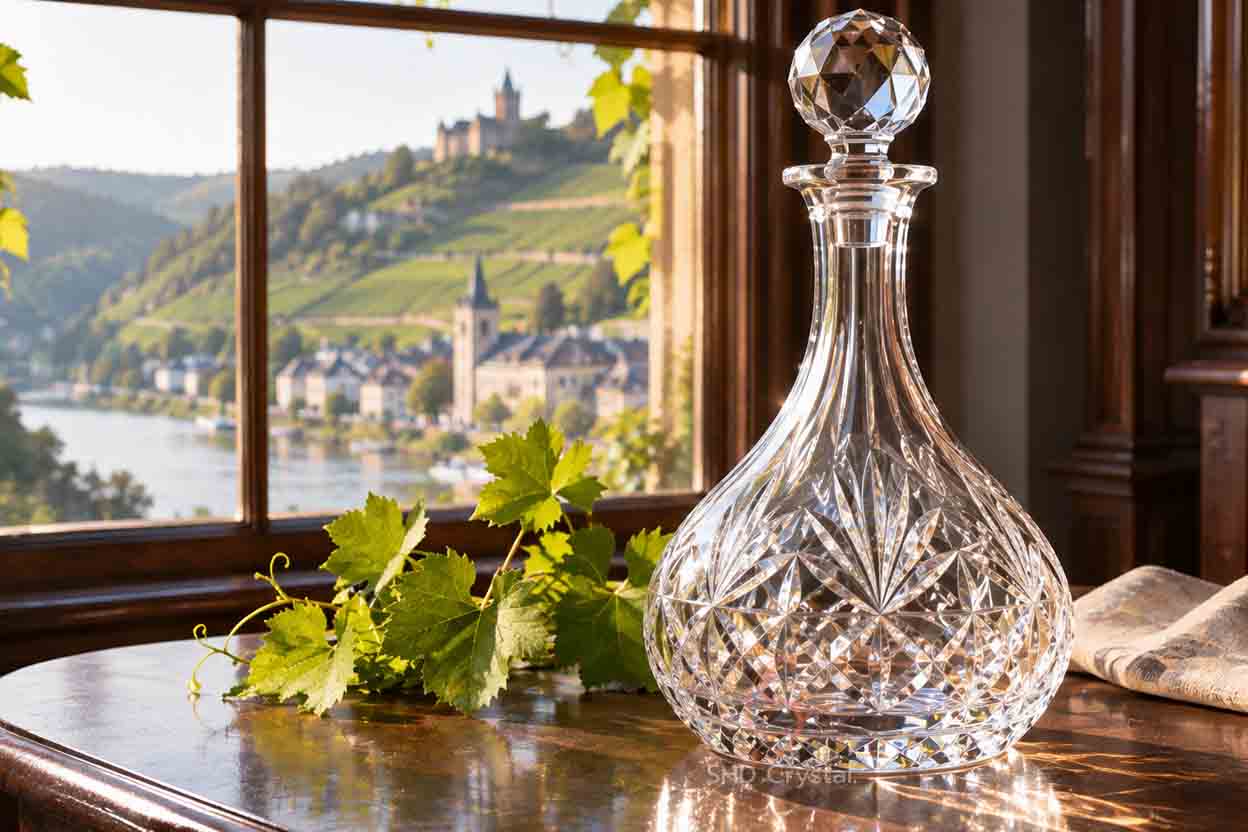
Germany’s glassmaking heritage and wine culture have developed across different regions, each contributing its own traditions of craftsmanship and appreciation. The german lead crystal decanter offers an interesting perspective on these two cultural worlds. With its carefully cut patterns, polished surfaces, and elegant proportions, it reflects the artistry of decorative glass while evoking the refined atmosphere of traditional wine service. Its appeal becomes even more meaningful when explored through Germany’s diverse regional histories.
From southern glassmaking workshops to vineyards along the Rhine and Moselle, this relationship offers a distinctive way to understand the decanter as both a vessel and a decorative object.
German Lead Crystal Decanter Design Across Regional Traditions
Germany does not have one uniform glassmaking style. Different regions have developed their own materials, techniques, and artistic specialties, contributing to a broader appreciation of decorative glass.
From the Bavarian Forest to Thuringia
The Bavarian Forest is among Germany’s best-known glassmaking regions, with a manufacturing and processing history extending more than 700 years. [1] Further north, Lauscha in Thuringia became an important center of glassblowing after a glassworks was established in 1597. Its traditions are particularly associated with artistic glass and delicate blown decorations. [2] These regional histories are different, yet both illustrate the importance of skilled forming and finishing in German glass culture.
A traditional hand-cut crystal decanter belongs to this broader appreciation of craftsmanship, although its particular design or production origin must be established independently.
Wine Culture Beyond a Single German Region
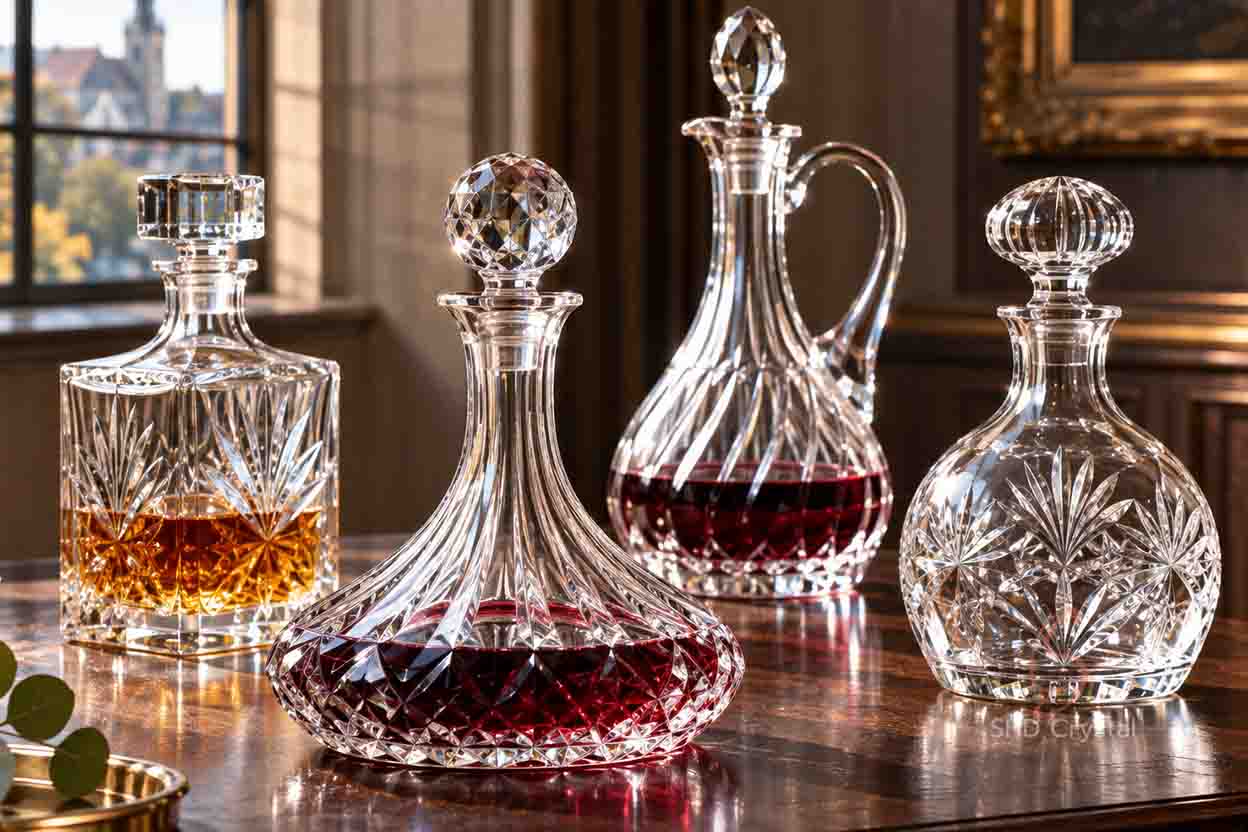
The decanter also finds a natural setting within Germany’s diverse wine culture. The Mosel is recognized for its long winegrowing history, while the Rheingau is closely associated with Riesling. Baden and Württemberg bring different regional traditions, and vineyards in Sachsen and Saale-Unstrut demonstrate that German wine culture extends into the country’s east. [3] These differences invite varied approaches to glassware presentation. A slender decanter may complement a formal dining arrangement, while a broad-based wine carafe creates a more contemporary appearance.
The appropriate design ultimately depends on the wine, serving purpose, and table setting rather than geographical inspiration alone.
Why Traditional Crystal Decanters Look So Distinctive
A classic german lead crystal decanter may feature a rounded or angular body, an elongated neck, a substantial base, and a carefully fitted stopper.
Decorative cutting adds another dimension. Diamond patterns create intersecting reflections, vertical flutes emphasize height, and polished starburst motifs introduce geometric detail. For a hand-cut crystal decanter, these patterns are produced through controlled glass removal and subsequent polishing. Their clarity depends on cutting accuracy, suitable wall thickness, and refined finishing.
The stopper deserves equal attention. Its proportions should complement the vessel, while its fit must meet the intended functional requirements.
Lead Crystal and the Modern Wine Table
Traditional lead crystal is valued for its optical properties and decorative cutting characteristics. Under European crystal-glass classifications, lead crystal 24% contains at least 24% PbO, while full lead crystal 30% contains at least 30%. [4] However, the presence of intricate cutting does not establish the actual glass composition. There is also a practical distinction between collecting historical crystal and selecting a decanter for regular wine service.
Lead can migrate from crystal into beverages, particularly acidic drinks such as wine. Prolonged storage increases this concern. [5]
For contemporary drinking applications, a suitable lead-free wine decanter is generally the safer choice, while traditional lead-crystal pieces can retain their decorative and collectible appeal.
Bringing Classical Design into Contemporary Collections
German-inspired decanter design does not have to reproduce an antique object. A modern collection might retain geometric cutting while simplifying the stopper, reducing ornamentation, or introducing a more restrained silhouette.
For original projects, designers should consider the relationship between material composition, capacity, pouring performance, base stability, and surface finishing.
For original projects, designers should consider the relationship between material composition, capacity, pouring performance, base stability, and surface finishing.
A lead-free wine decanter can incorporate traditional decorative details without reproducing the lead-containing material itself. This allows heritage-inspired design to develop in a direction suited to contemporary hospitality and giftware collections.
Conclusion
The german lead crystal decanter reflects more than a particular glass shape. It connects decorative cutting, regional craftsmanship, and the visual traditions of German wine culture. Its continuing appeal lies in how these influences can be preserved, reinterpreted, and adapted to modern materials without losing their original character.
A Heritage-Inspired Decanter with Its Own Identity
At SHD Crystal, the design language of the german lead crystal decanter offers inspiration for original glassware concepts. Classical cutting patterns, balanced proportions, and carefully selected materials can help shape a contemporary collection that respects tradition while developing an identity of its own.
References
[1] Bavarian Forest — Eastern Bavaria Tourism: https://www.ostbayern-tourismus.de/region/bavarias-historical-and-natural-treasure/bavarian-forest
[2] Geschichte — Stadt Lauscha: https://www.lauscha.de/geschichte.html
[3] Regionen — Deutsches Weininstitut: https://www.ch.deutscheweine.de/regionen
[4] Crystal Glass Products — Government of Slovenia: https://www.gov.si/en/topics/crystal-glass-products
[5] Lead Crystalware and Your Health — Health Canada: https://www.canada.ca/en/health-canada/services/healthy-living/your-health/products/lead-crystalware-your-health.html
https://shdcrystal.com/blogs/german-lead-crystal-decanter/
The link to this article is managed and owned by SHD Crystal. Please cite the source if reposting. Thank you for your cooperation.