
Glass and wood fit tolerance is one of the most important factors in multi-material product development, yet it is often addressed too late. On paper, a glass container and a wooden lid may appear to match perfectly. In real production, however, those two components are shaped, finished, stored, and handled under very different conditions. The result is that assembly problems frequently appear only after sampling begins. A design that looks precise in CAD may still feel too tight, too loose, or inconsistent once real materials are brought together.
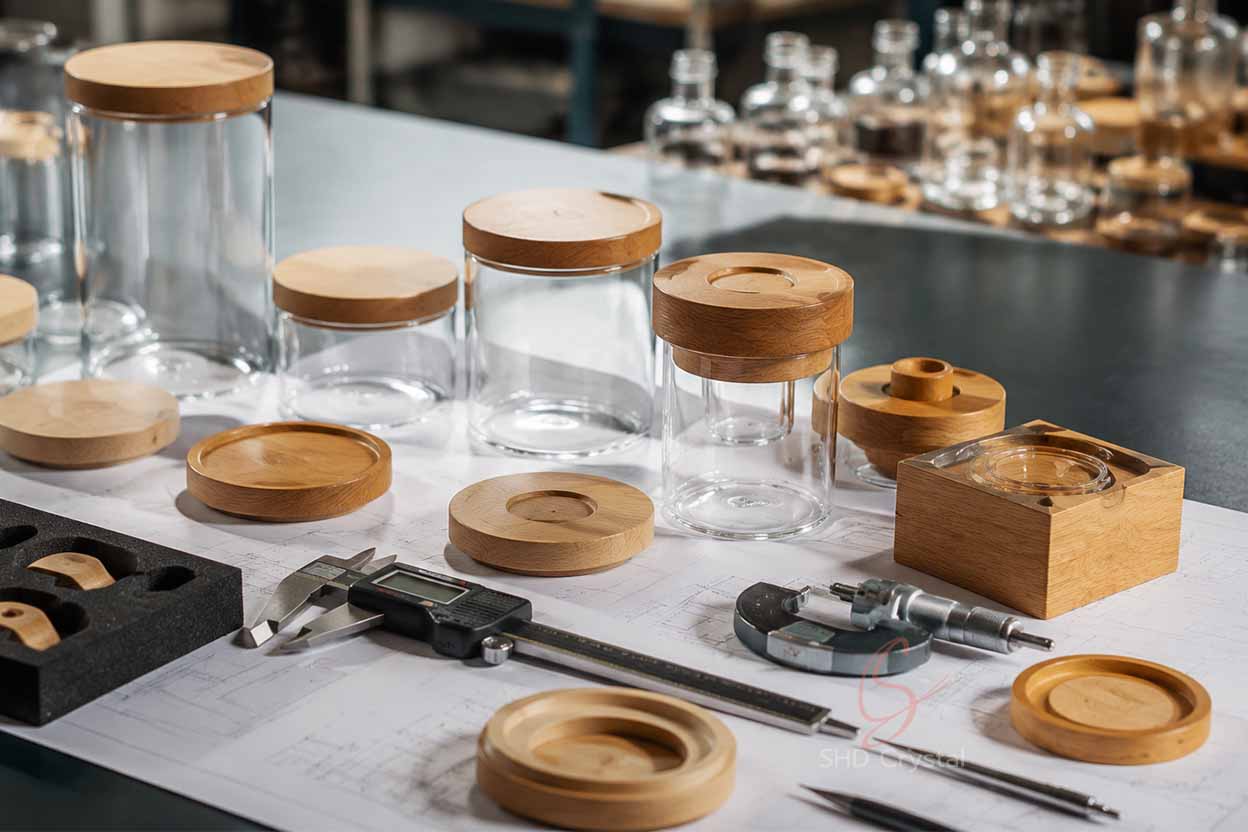
Why Glass And Wood Fit Tolerance Must Be Defined Before Sampling
The purpose of glass and wood fit tolerance is not simply to leave a gap between two components. It is to create a controlled relationship that allows assembly, stability, and repeat production to work together.
Glass is generally stable after forming and annealing, although normal variation may still exist in the opening diameter, rim profile, or wall thickness. Wood behaves differently. It can change dimension with humidity, machining direction, sanding, coating thickness, and storage conditions. That difference is why glass wood assembly should be designed around functional clearance rather than theoretical perfect contact.
Many projects run into problems because the fit is defined only by nominal dimensions. A drawing may show a wooden lid at the same diameter as the glass opening, but that does not explain what happens after varnish, oil, lacquer, or moisture change alters the final wood size.
Why Tight Fit Is Not Always Better
A common misunderstanding is that tighter fit means higher quality. In practice, an overly tight fit often creates more problems than it solves.
If the wood insert or lid is made too close to the glass opening size, normal production variation may lead to difficult assembly, inconsistent user experience, excessive insertion force, or even scratching and chipping at the rim. A fit that feels secure during one dry-season sample review may become problematic after transport or seasonal humidity changes.
This is an important engineering trade-off. A tighter fit may improve perceived precision, but it reduces tolerance for variation. A looser fit improves assembly consistency, though too much clearance may affect stability or visual quality. The best solution depends on how the product will actually be used.
The Materials Do Not Respond the Same Way
The challenge in dimensional matching comes from the material difference itself. Glass dimensions are mainly affected by forming tolerance, mold condition, cooling behavior, and any post-forming edge finishing. Wood dimensions are affected by species, grain orientation, moisture content, machining accuracy, sanding, and coating build-up. Surface finishing is especially easy to underestimate. A wood component may measure correctly before finishing, then become too tight after sealers, paints, or oils are applied.
This is why a functional glass wood assembly should always be reviewed with the real finished parts rather than bare unfinished components. Ignoring finishing thickness is a common cause of late-stage fit problems.
Different Products Need Different Fit Strategies
Not every product needs the same approach. Decorative assemblies often allow more flexibility than functional ones.
Examples that typically need tighter control include:
-Glass jars with wooden lids
-Candle vessels with fitted wood covers
-Glass containers with stopper-style wood inserts
-Lighting components with wood mounting parts
Products that may allow more visual clearance include:
-Glass domes with wooden display bases
-Decorative cloches
-Home décor vessels
-Tabletop display components
Function should define the fit. If the wood part is expected to seal, locate, or support the glass precisely, the tolerance strategy must be stricter than for a purely decorative base.
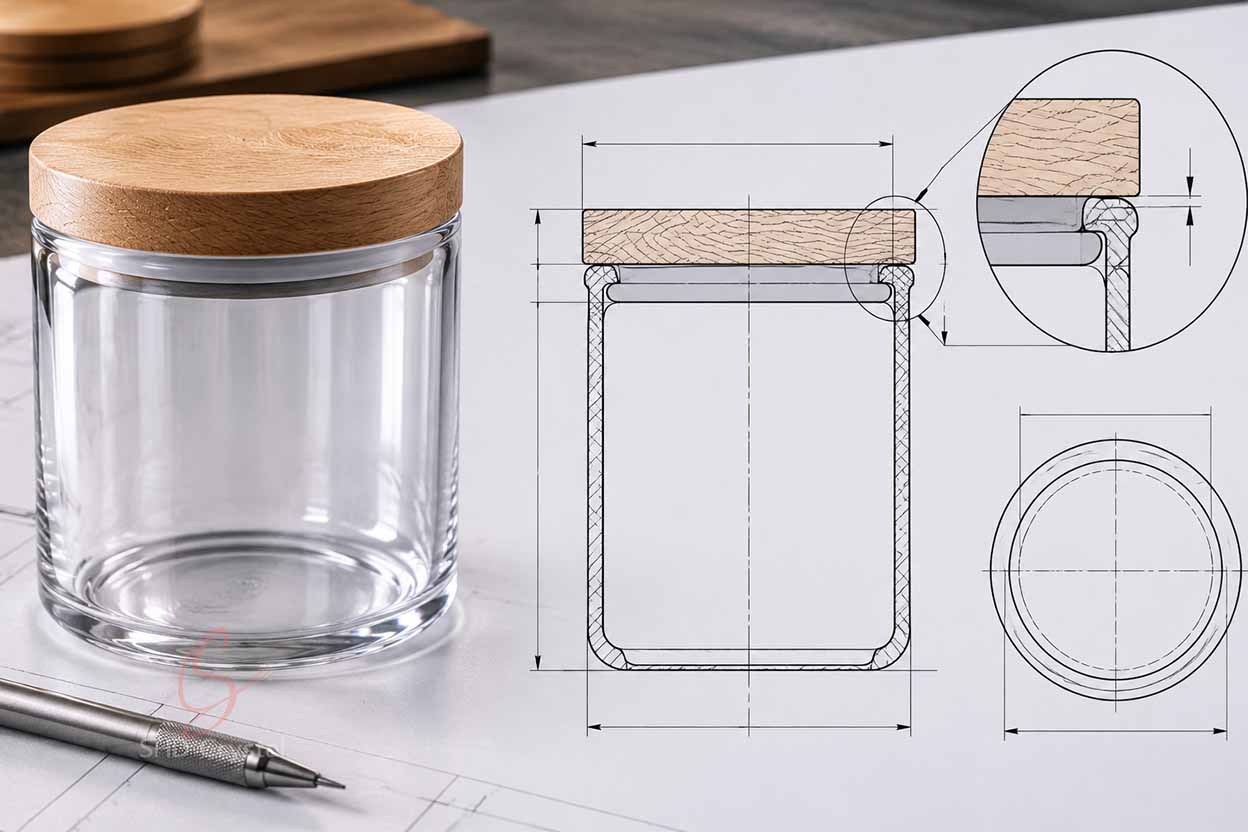
Sampling Is the Most Reliable Way to Confirm Fit
Digital drawings can define target dimensions, but they cannot fully predict insertion force, tactile feel, coating build-up, or how the fit changes after transport and storage. For that reason, prototype testing is essential.
During sampling, teams should check:
- Assembly force
- Stability during use
- Visual gap consistency
- Rim contact condition
- Coating influence
- Repeatability across multiple samples
One sample is not enough. Fit should be evaluated across several glass pieces and several wood pieces, especially when both materials are produced in batches. That is often the only practical way to see whether the proposed glass and wood fit tolerance works under real manufacturing conditions.
Conclusion
Glass and wood fit tolerance is a practical design requirement, not a minor engineering detail. Because glass and wood behave differently during production and use, successful glass wood assembly depends on planned clearance, realistic dimensional matching, and sample-based verification. Projects that define fit requirements early usually achieve more stable assembly, fewer revisions, and better production consistency.
Improving Multi-Material Product Development
For glass jars, candle vessels, domes, lighting parts, and decorative home products, SHD Crystal can support glass and wood fit tolerance review through sample comparison, dimensional evaluation, assembly testing, and production planning. Early discussion of material behavior, finish thickness, and use conditions helps create a more reliable glass wood assembly strategy before mass production begins.
Read the original full version:
https://shdcrystal.com/blogs/glass-and-wood-fit-tolerance/