
Glass grain jar production looks straightforward from the finished product: a clear container, a wide opening, a stable base, and enough capacity for rice, oats, beans, cereal, seeds, or other dry foods. On the forming line, however, these jars present several practical challenges. Their larger bodies, broad mouths, straight walls, and relatively high glass weight require stable gob control and careful glass distribution if thousands of jars are expected to look and perform alike.
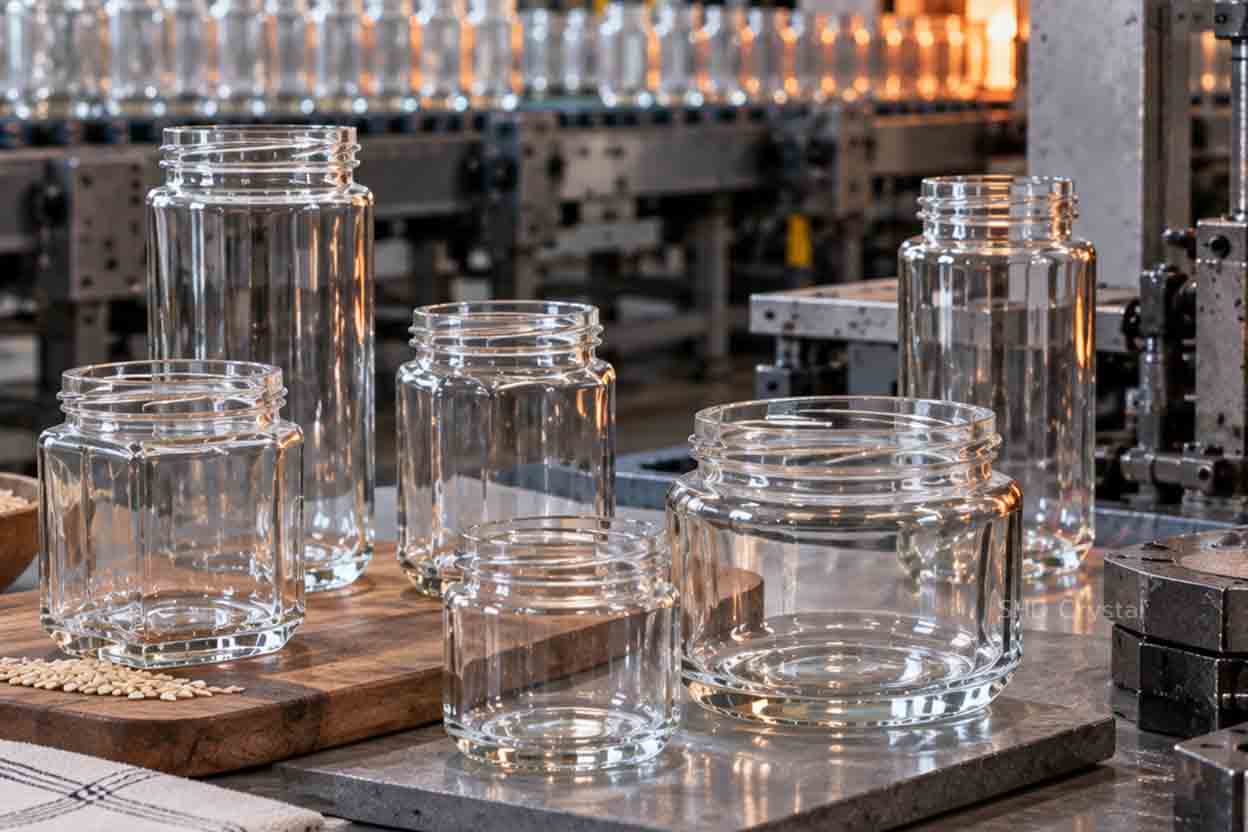
Glass Grain Jar Production Starts With the Right Forming Logic
Most glass grain storage jars are designed around accessibility. Users need to pour ingredients easily, scoop them with a spoon, and clean the interior without struggling with a narrow neck. That is why wide-mouth structures are so common.
During production, molten glass is first divided into controlled gobs. Each gob must contain enough material for the target jar weight. It then enters the forming machine, where the preliminary cavity is established before the jar reaches its final mold.
For many wide-mouth containers, wide mouth glass jar forming can use press-and-blow principles. A plunger helps distribute the hot glass and establish the internal shape before compressed air completes the final body against the mold.
Larger Bodies Need Controlled Glass Distribution
A grain jar usually has more internal volume than a small condiment container. That does not mean simply adding more glass everywhere. Too much material concentrated in the base makes the jar unnecessarily heavy. Too little glass in the upper wall or shoulder area can create uneven appearance and weaker structural balance.
In glass grain jar production, gob weight, forming temperature, mold condition, and cycle timing all influence where the glass finally settles. Straight-sided jars make these differences particularly visible because large clear panels expose variations in wall thickness. For glass grain storage jars, consistent transparency is part of the product appearance. A distorted panel or unusually heavy section can be noticed quickly once several jars are placed together.
Round, Square, and Tall Jars Behave Differently
Round grain jars are generally friendly to forming because their symmetrical walls allow glass to distribute more evenly around the cavity.
Square jars require greater attention at the corners. Molten glass must reach these areas before it loses too much forming temperature, otherwise the edges may appear poorly defined.
Tall containers introduce another issue: vertical distribution. The glass must stretch farther from mouth to base while maintaining suitable wall balance.
This is why wide mouth glass jar forming cannot be treated as one fixed process for every shape. The opening may be similar, but the body geometry changes how the glass flows.
Mouth Accuracy Matters for Everyday Storage
The mouth is one of the most functional parts of glass grain storage jars. Standard grain jars may use metal lids, plastic screw caps, glass lids, or other stock closure systems. Regardless of the lid style, the finish needs consistent diameter, roundness, and rim condition.
A common misconception is that dry-food storage jars do not require much closure control because they are not liquid containers. In reality, poor mouth consistency can still cause loose lids, awkward assembly, or an uneven appearance after packing.
Annealing Completes the Forming Process
After forming, the jars move through an annealing lehr for controlled cooling. This stage is especially relevant to larger jars because the base, corners, and body walls may cool at different rates. Proper annealing reduces residual stress before the containers enter inspection and packing. Finished jars can then be checked for dimensions, rim quality, cracks, base stability, visible forming defects, and overall consistency.
Conclusion
Glass grain jar production turns a familiar household container into a repeatable industrial product. Wide mouths improve access, large bodies provide useful storage capacity, and different round, square, or tall shapes create their own forming requirements.
Stable wide mouth glass jar forming, controlled glass distribution, accurate mouth finishes, and proper annealing are what allow glass grain storage jars to remain simple in appearance while performing reliably in everyday food storage.
Standard Grain Jar Production With SHD Crystal
SHD Crystal supports automated glass grain jar production across standard round, square, straight-sided, wide-mouth, and large-capacity jar formats. Production capabilities include gob forming, automated molding, annealing, conveying, dimensional and appearance inspection, and export packing.
For standard glass grain storage jars, the production focus is consistent dimensions, stable bases, clear glass appearance, controlled wall distribution, and reliable wide mouth glass jar forming for subsequent lid assembly, packing, and commercial supply.
Read the original article on custom crystal glass manufacturing: https://shdcrystal.com/blogs/glass-grain-jar-production/