
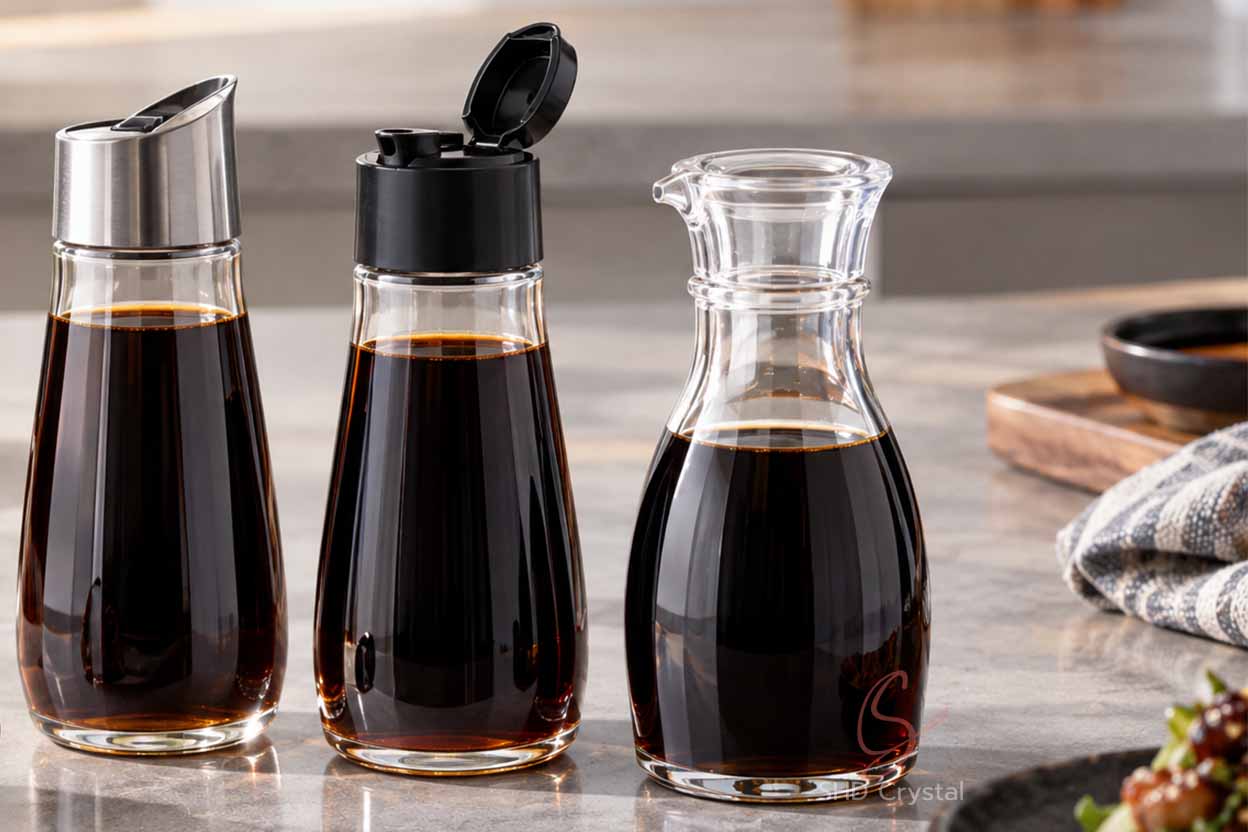
A glass soy sauce bottle with lid may appear to be one of the simplest objects on a dining table. Yet anyone who has watched soy sauce run down the side of a bottle knows that a convenient dispenser depends on more than its appearance. A suitable pouring spout, comfortable bottle body, stable base, and properly fitted lid all contribute to everyday use. For kitchenware brands and glass manufacturers, these details determine whether a decorative container becomes a reliable tabletop product.
Glass Soy Sauce Bottle With Lid Design Begins With Pouring Control
The purpose of a tabletop soy sauce bottle is straightforward: deliver a controlled amount of seasoning without unnecessary dripping or mess.
A useful historical example is Kikkoman’s classic glass tabletop dispenser, introduced in 1961. Its distinctive cap and pouring arrangement were developed to improve liquid control and reduce dripping. The design demonstrates how a relatively small component can significantly influence the usefulness of an entire container.
Modern soy sauce dispenser bottle designs follow the same practical principle, although their materials, shapes, and closure systems vary.
The Lid and Pouring Spout Perform Different Functions
A lid may protect the opening from dust, while a shaped spout helps direct liquid flow. Some dispensers combine these functions in a removable pouring cap, while others use flip-top covers or additional closing components.
These arrangements should not be treated as interchangeable. A drip-resistant spout does not automatically make a bottle leakproof when overturned. Similarly, a removable cap may be convenient for refilling without providing an airtight seal.
For product development, the intended use must be established before selecting the closure. A tabletop dispenser used repeatedly during meals has different functional requirements from a bottle intended for sealed transportation.
Glass Shape Influences Handling and Stability
Clear glass allows users to see the remaining soy sauce and provides a clean appearance suitable for different kitchen and dining styles.
However, the shape still matters.
A compact rounded bottle may be comfortable to hold, while a straight-sided design creates a more structured appearance. A wider base can improve standing stability, particularly when the container is nearly empty.
The neck opening must accommodate the selected lid without making refilling or cleaning unnecessarily difficult. For a glass condiment bottle, excessive thickness is not automatically an advantage. Additional glass increases weight, while the overall durability still depends on geometry, wall distribution, forming quality, and annealing.
Easy Cleaning Should Be Considered Before Decoration
Soy sauce can leave residue around pouring openings, cap interfaces, and narrow internal passages. A removable lid and an accessible bottle opening can simplify cleaning. The pouring component should also be reviewed for areas where seasoning may accumulate after repeated use.
Decoration can include molded ribbing, subtle embossing, printing, or limited frosting. However, surfaces that contact the sauce must use suitable food-contact materials, and decorative finishes should not compromise cleaning or normal handling.
For restaurant applications, cleaning instructions and component replacement requirements can be as important as appearance.
Manufacturing Accuracy Matters at the Bottle Neck
From a manufacturer’s perspective, the most important details are not necessarily the largest ones. The glass body may be produced through a suitable mold-forming process, followed by controlled annealing and inspection. The neck finish, however, needs particular dimensional consistency because it connects directly with the lid.
Variation in mouth diameter, threads, sealing surfaces, or rim condition may affect cap installation and closure performance. When a soy sauce dispenser bottle uses a separate stainless steel or plastic pouring component, the assembled product should be evaluated for fitting accuracy, pouring performance, potential leakage, and material compatibility.
Physical sampling is particularly useful because successful closure performance cannot be confirmed from the glass bottle alone.
Conclusion
A glass soy sauce bottle with lid succeeds when its glass body and closure system perform as one product. Pouring control, stable proportions, accessible cleaning, and accurate cap fitting matter more than decorative complexity.
For brands developing a glass condiment bottle collection, careful attention to these practical details can transform a familiar kitchen accessory into a product suitable for daily dining and repeat production.
Developing Glass Soy Sauce Bottles With SHD Crystal
SHD Crystal provides glass manufacturing support covering mold development, glass forming, annealing, surface finishing, quality inspection, and packaging preparation. For a glass soy sauce bottle with lid, product development can begin with the intended capacity, bottle geometry, neck dimensions, closure selection, and pouring requirements.
SHD Crystal can support glass body design and mold evaluation while coordinating the dimensional requirements of separately manufactured lids and pouring components. Transparent glass, molded surface patterns, and suitable decorative finishes can also be considered according to the intended kitchenware collection. Through sample inspection and production planning, SHD Crystal helps buyers evaluate bottle consistency, closure compatibility, glass quality, and packing protection before commercial production.
Frequently Asked Questions
Does a Glass Soy Sauce Bottle Keep Soy Sauce Fresh Longer Than Plastic?
Not necessarily. Glass provides a nonporous container surface, but freshness after opening also depends on oxygen exposure, light, temperature, hygiene, and the sealing performance of the closure. Users should follow the soy sauce producer’s storage instructions rather than assuming that a glass bottle automatically extends shelf life.
Can the Same Soy Sauce Dispenser Be Used for Thick Sauces?
Not always. Thin soy sauce, sweet soy sauce, and thicker condiments may behave differently through the same pouring spout. Narrow openings can restrict flow or become difficult to clean when used with viscous products. The dispenser should be tested with the intended liquid.
Can Replacement Lids Be Ordered Without Replacing the Glass Bottle?
Potentially, if the glass neck dimensions and closure specifications remain consistent. For kitchenware brands and restaurant operators, standardized components can simplify maintenance and replacement purchasing. Compatibility should be confirmed using actual bottle and lid samples.
Read the original full version: https://shdcrystal.com/blogs/glass-soy-sauce-bottle-with-lid/