

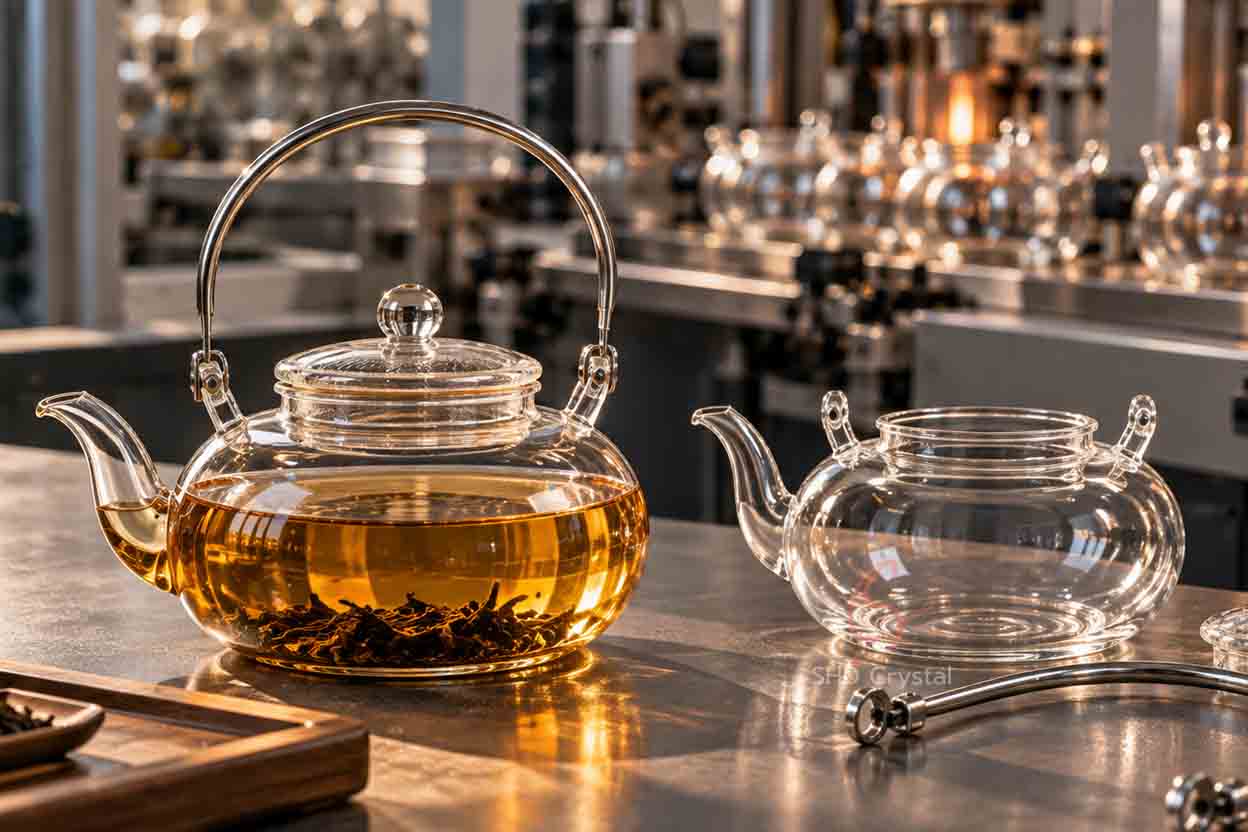
A glass teapot with stainless handle is designed for serving hot water or brewing tea, combining a transparent glass body with a separately manufactured metal handle. In traditional Chinese-style designs, the vessel typically features a rounded body, a relatively wide opening, a short pouring spout, and an arched handle attached near the upper sides. For suitable designs, the glass body can be produced through automated mold-forming methods rather than manual glass blowing or hand shaping. The stainless steel handle is installed after the glass has completed forming, annealing, and inspection.
Glass Teapot With Stainless Handle Production Begins With the Mold
The main difference between this teapot and a conventional glass container is its intended use. It must accommodate hot tea, support controlled pouring, remain stable during serving, and provide reliable attachment points for the metal handle. These requirements need to be considered before glass forming begins.
Choosing Between Press-and-Blow and Blow-and-Blow
Automated container forming commonly uses press-and-blow or blow-and-blow processes. In press-and-blow forming, a plunger creates the preliminary hollow shape before compressed air expands the glass against the final mold. This method is commonly associated with wide-mouth containers, making it a potential option for teapot bodies with relatively large openings; Blow-and-blow forming uses compressed air during both preliminary and final shaping stages. It is traditionally associated with narrower-neck containers, although actual manufacturing capabilities depend on the equipment and tooling.
For a machine blown glass teapot, the selected method must accommodate the body dimensions, mouth opening, pouring spout, glass distribution, and intended material. A short spout and external handle attachment features also require a mold design that permits reliable forming and release.
Once a compatible forming system is established, the glass body can take shape rapidly in a repeatable mechanical cycle.
Heat Resistance Depends on More Than Forming Speed
Unlike a cold-drink pitcher, a glass tea vessel is exposed to elevated liquid temperatures during normal use. Borosilicate glass is often selected for heat-resistant teaware because of its relatively low thermal expansion. However, its suitability for automated forming must be confirmed against the available equipment and process conditions.
The body structure also matters. Uneven glass distribution, abrupt wall transitions, and residual stress can influence thermal performance. Following forming, the glass passes through controlled annealing to reduce internal stress. Quality inspection should then address the rim, spout, base, wall consistency, visual defects, and handle mounting areas.
A teapot designed to receive freshly boiled water is not automatically suitable for direct heating on a stove. Such applications require separate product-level validation.
The Stainless Steel Handle Is Installed After Glass Production
The curved metal handle is manufactured independently from the glass body. For designs using two side attachment points, the glass body must provide correctly positioned mounting features. These can take the form of external glass lugs with prepared openings, allowing the metal handle to connect without penetrating the liquid-containing chamber. Their geometry must be compatible with the selected glass-forming process. Any required secondary machining or finishing must also be reviewed for structural and thermal suitability.
After annealing and inspection, the prepared stainless steel handle is fitted to these mounting positions using the specified connection components.
Stainless steel handle assembly requires attention to attachment security, alignment, pouring balance, metal-to-glass contact, and potential heat transfer. Suitable cushioning or insulating components may be necessary depending on the handle construction. The result is a complete tea vessel assembled from two different materials, each manufactured for its own structural and functional purpose.
Final Inspection Focuses on Hot Tea Service
A finished glass teapot needs more than visual consistency. The lid should sit correctly, the spout should pour predictably, and the assembled handle should support controlled lifting under the intended service conditions. Where a removable tea infuser is included, its fit and clearance also need evaluation.
For products intended to receive hot water, thermal performance must be validated against the specified use conditions. Additional testing is required if direct heating is part of the intended application. These checks help distinguish functional tea-making glassware from decorative containers that merely resemble teapots.
Conclusion
A glass teapot with stainless handle combines efficient glass forming with carefully planned metal-component assembly. Press-and-blow or blow-and-blow forming may be considered according to the body geometry, opening size, material, and equipment capabilities.
The glass body is formed first, followed by annealing, inspection, and stainless steel handle assembly at the prepared side attachment points. For hot-water and tea-serving applications, successful production also depends on material selection, thermal performance, spout design, handle reliability, and final product testing.
Glass Teapot Manufacturing Support From SHD Crystal
SHD Crystal provides glass manufacturing capabilities covering mold development, automated glass forming, annealing, finishing, and quality inspection. For a glass teapot with stainless handle, SHD Crystal can evaluate the glass body design against the intended forming process, with particular attention to the rounded vessel structure, mouth diameter, short spout, wall distribution, and handle attachment features.
Development planning can also cover material requirements for hot beverage use, dimensional inspection, and compatibility with the separately manufactured stainless steel handle. The final forming method and any required secondary operations should be confirmed through engineering review and physical sampling.
By considering glass forming, heat-use requirements, and handle assembly together, SHD Crystal can support the development of functional glass teaware intended for repeatable production.
FAQs About Glass Teapot With Stainless Handle
Q01 | Why Do Some Hot-Water Glass Teapots Use Soda-Lime Glass Instead of Borosilicate?
Soda-lime glass is widely used in commercial glassware because of its established manufacturing processes, material availability, and production economics. However, this does not mean that most heat-resistant teapots are made from soda-lime glass. Borosilicate glass remains a common choice for products designed to handle hot water and temperature changes. Material selection depends on the intended application, forming process, structural design, and verified thermal performance.
Q02 | Can Tempered Soda-Lime Glass Offer the Same Heat Resistance as High Borosilicate Glass?
Not exactly. Thermal tempering can improve the mechanical strength and thermal-shock resistance of suitable soda-lime glass products, but it does not change the material’s inherently higher thermal expansion coefficient. High borosilicate glass generally offers better resistance to rapid temperature changes. A tempered soda-lime teapot may perform reliably within its validated operating conditions, but suitability for boiling water or direct heating must be established through product-specific testing.
Q03 | Are Soda-Lime Glass Teapots More Popular Simply Because They Break More Often and Need Replacing?
There is no reliable basis for attributing material selection to an intention to encourage replacement purchases. Soda-lime glass can offer manufacturing efficiency, established production infrastructure, and competitive pricing, while tempering and appropriate structural design can improve durability in suitable applications. Manufacturers also have commercial reasons to reduce breakage, product returns, and safety complaints. Buyers should compare tested thermal performance, mechanical durability, production consistency, and intended use rather than assuming that a lower-cost glass material is deliberately less durable.
The link to this article is managed and owned by SHD Crystal. Please cite the source if reposting. Thank you for your cooperation.
https://shdcrystal.com/blogs/glass-teapot-with-stainless-handle/