
On supermarket shelves, those green beer bottles look strikingly simple; yet, once you stand beside the production line, you realize that green beer bottle production is far from simple. The finished bottle has a familiar shape, a green body, a narrow neck, and a stable base. Behind that calm appearance, however, automated glass bottle production has to control molten glass weight, forming, neck dimensions, color consistency, annealing, inspection, and conveyor movement again and again. One nice-looking bottle is easy to admire. Thousands of similar ones are where manufacturing starts showing off.
Green Beer Bottle Production Begins With a Very Hot Piece of Glass
The process starts with molten glass being cut into controlled portions known as gobs. Each gob contains approximately the amount of glass required for one bottle before entering the forming machine.
From there, industrial container production commonly uses a two-stage forming process. The gob first enters a blank mold to establish the preliminary shape and glass distribution, then moves into the final mold where compressed air helps form the finished bottle geometry. After forming, the bottles pass through an annealing lehr before cold-end inspection.
It sounds beautifully organized when written in one paragraph.
The glass itself has other opinions. The Green Color Has to Stay Green—Not “Almost Green”
For conventional green glass beer bottles, the color is generally created within the glass itself rather than sprayed onto the finished bottle like decorative perfume packaging.
Glass composition, coloring species, recycled glass input, and the oxidation-reduction condition of the melt can all influence the final tone. Industrial glass research notes that controlling melt chemistry is important for maintaining color stability, particularly with green glass formulations. This matters because one green bottle viewed alone may look perfectly acceptable.
Put several hundred together and suddenly a slightly different shade becomes much easier to notice. Wall thickness also changes how dark the glass appears. A heavier base can look deeper green than a thinner body wall even when both are made from the same glass batch.
So “make it green” is technically a much shorter sentence than the job it describes.
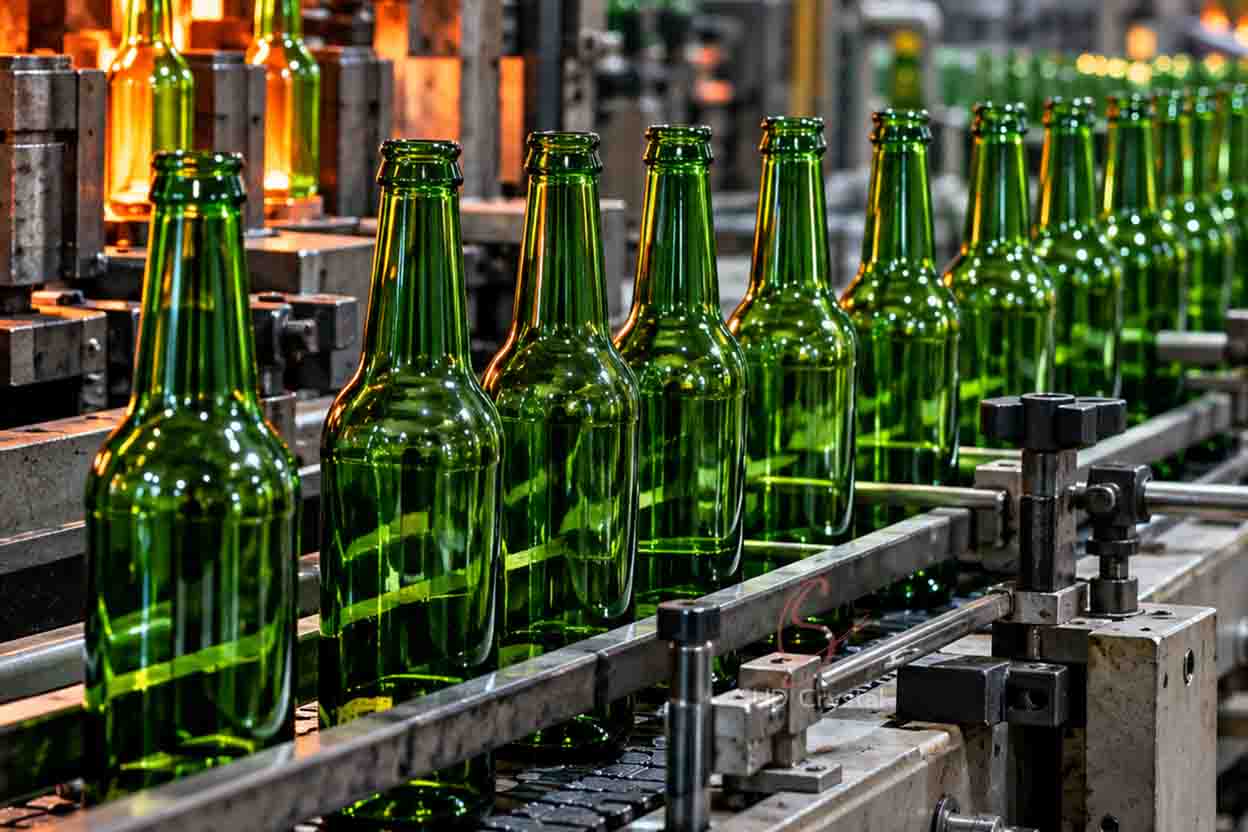
The Neck Is Small but Has Very Little Freedom
The bottle body gets most of the visual attention, but the neck finish has a more demanding job. Green glass beer bottles need sufficiently controlled neck geometry for the intended closure and filling system. Diameter, roundness, height, and finish geometry need to remain repeatable as bottles move through high-volume production.
SHD Crystal’s own automated bottle-production content similarly identifies neck finish consistency as one of the important control points because dimensional variation can create problems later during filling and capping.
The neck may occupy only a small percentage of the bottle. It apparently did not receive the memo about being a minor feature.
The Blank Mold Quietly Decides a Lot
During automated glass bottle production, the blank mold establishes the preliminary glass distribution before the bottle reaches its final shape. This matters around the shoulder, sidewall, heel, and base. If glass is distributed poorly early in the process, the final mold cannot magically redistribute everything into perfection.
Too much glass concentrated at the bottom can add unnecessary weight. Too little around another area can contribute to inconsistent wall distribution. That is why automated production is not simply about running machines quickly. The real advantage comes from keeping forming conditions controlled enough for bottles to repeat the intended geometry over long production runs.
Annealing Is the Part Where Glass Learns to Relax
A newly formed bottle leaves the forming machine extremely hot. Allowing it to cool randomly would be a poor career decision. Instead, bottles travel through an annealing lehr where temperature is reduced in a controlled manner to help relieve internal stress created during forming. Industrial container-glass producers use this stage specifically to improve the structural reliability of bottles and jars after molding.
For green glass beer bottles, controlled annealing becomes part of maintaining reliable output across a large batch rather than simply producing bottles that look correct while they are still hot.
The Inspection Machines Start Judging Everyone
Once bottles reach the cold end, inspection becomes the final reality check. Depending on the production setup, automated systems can evaluate characteristics such as dimensions, neck finish, wall conditions, cracks, inclusions, base defects, and other abnormalities before unsuitable bottles continue downstream. Modern container-glass manufacturing commonly combines camera, mechanical, optical, and dimensional inspection methods.
This is where automated production becomes particularly valuable. Making bottles faster is useful. Making bottles faster while identifying the ones that should not continue toward filling is considerably more useful.
Automation Is Really About Repeatability
A beer bottle is not normally purchased because someone wants to admire one exceptional piece of glass craftsmanship.
The commercial requirement is repetition. Bottle height, shoulder profile, neck finish, body diameter, base stability, color appearance, and wall distribution need to stay within practical production limits across large quantities.
SHD Crystal publicly lists automated machine forming alongside mold pressing and hand-blown manufacturing, with automated forming intended for higher-volume bottles, containers, cups, jars, and other products where stable geometry and output consistency are priorities. That distinction matters. Hand-blown glass can celebrate individuality. A beer filling line generally has less enthusiasm for individuality.
Conclusion
Green beer bottle production demonstrates what automated glass manufacturing does particularly well: turning molten material into highly repetitive commercial containers through controlled forming, annealing, conveying, and inspection.
For green glass beer bottles, the challenge is not producing one attractive bottle. It is maintaining green tone, neck dimensions, body geometry, base stability, and overall quality while automated glass bottle production keeps moving.
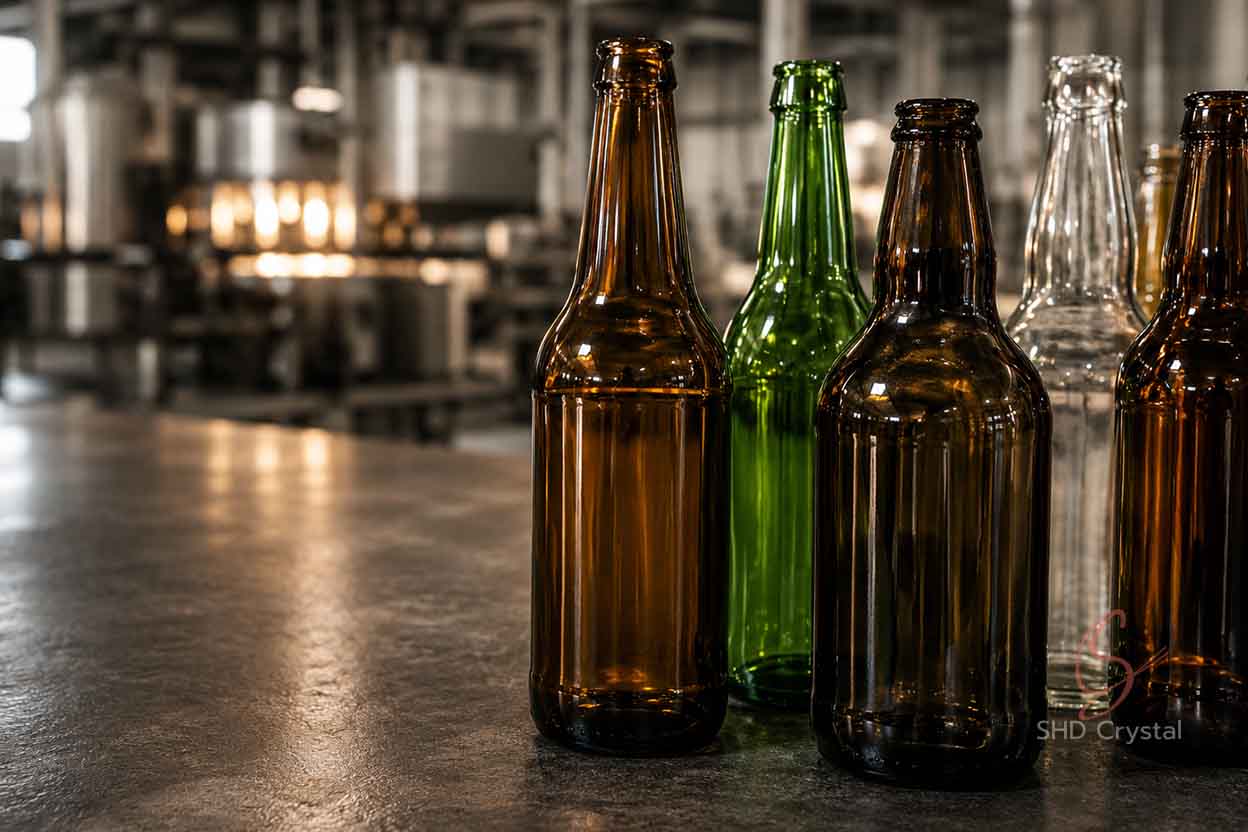
The bottle on the shelf may look ordinary. Producing thousands of them without giving each one its own personality is the impressive part.
Automated Glass Bottle Production With SHD Crystal
SHD Crystal combines automated forming with mold development, annealing, inspection, surface processing, and export preparation as part of its broader glass manufacturing capabilities. Its published production facilities include automated machine forming alongside hand-blown and mold-pressed processes, allowing different manufacturing routes to be selected according to product structure and production requirements.
For a green beer bottle production project, attention can be placed on bottle geometry, neck finish, glass distribution, green color consistency, base stability, forming repeatability, and downstream inspection. SHD Crystal already applies automated forming principles to bottle projects where consistent dimensions and commercial-volume production are required.
In short, the machinery does the repeating. The manufacturing experience is what makes sure it repeats the right thing.
Read the original full version:
https://shdcrystal.com/blogs/green-beer-bottle-production/