
In our experience, nail polish square bottle OEM projects work best when the discussion starts with function rather than appearance alone. A square bottle can make a shade range look more organized, improve shelf recognition, and provide cleaner decoration surfaces, but good nail polish packaging depends on more than visual order. The bottle also needs stable neck dimensions, reliable brush fit, comfortable cap handling, clear color display, and packing strength that supports retail distribution. That is why a cosmetic packaging supplier should review the bottle as a complete packaging system instead of treating it as a simple glass container.
How Nail Polish Square Bottle OEM Connects Shape With Product Use
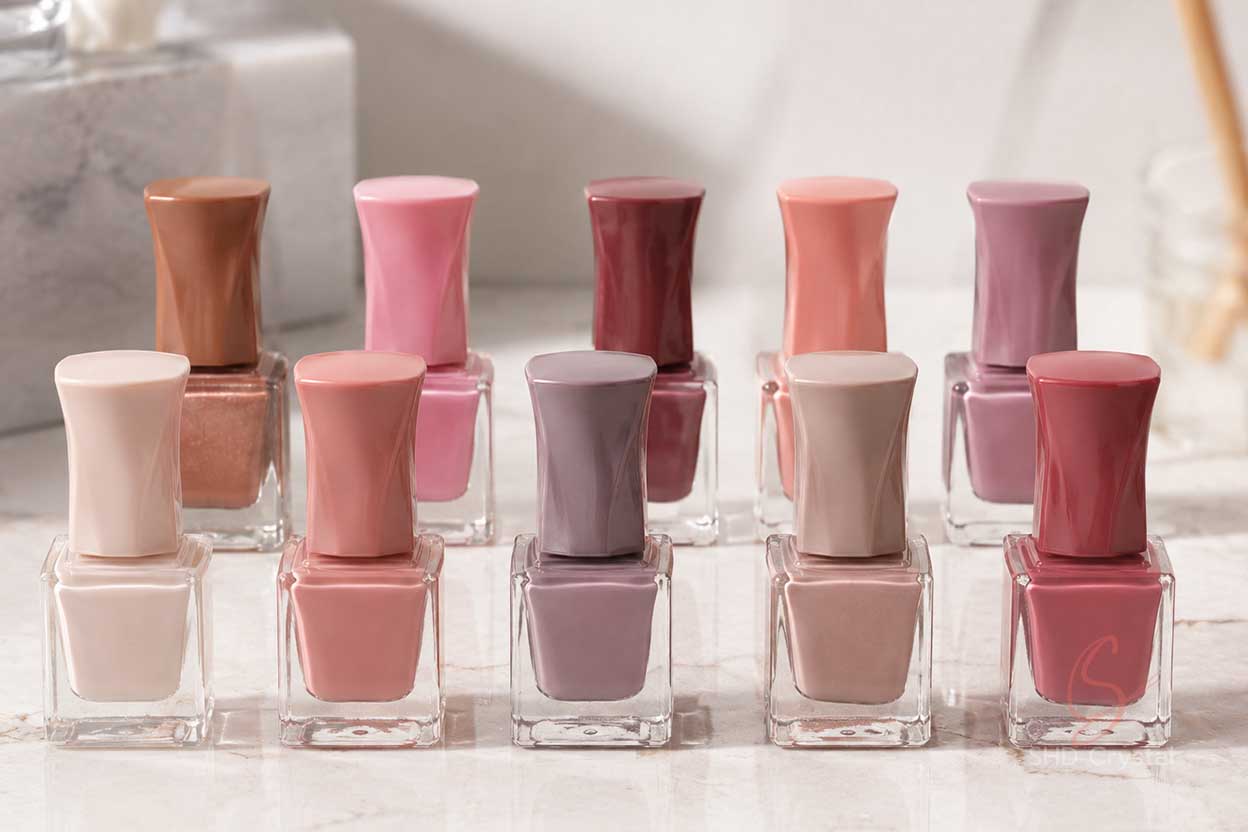
A square bottle is often chosen because it looks modern and structured. We regularly see beauty brands prefer this format when they want a collection to feel clean, premium, or highly coordinated on display. The flat panels are useful for logos, labels, and shade identification, while the geometric body can make a color line feel more consistent across multiple SKUs.
Even so, shape decisions should always be connected to use. If the bottle body is too wide, it may look strong on the shelf but feel awkward in the hand. If it is too narrow, it may lose the visual presence the brand originally wanted. In nail polish square bottle OEM development, body width, cap height, brush length, and target fill level should be reviewed together before sampling begins.
Neck Finish and Brush Fit Should Be Tested Together
The neck finish is one of the most important control points. Small dimensional differences can influence thread accuracy, cap alignment, sealing feel, and the way the brush moves inside the bottle. For nail polish, that interaction matters because the product is opened and closed repeatedly, and the consumer notices even small differences in handling comfort.
A reliable cosmetic packaging supplier should therefore test the actual brush and cap with the actual bottle structure, not just approve them separately. In our view, this is one of the most common areas where a project can look correct on paper but still feel wrong during real use. For nail polish square bottle OEM, the brush must enter smoothly without excessive contact against the internal wall, and the cap should close securely without misalignment.
Brush Reach Also Depends on the Internal Bottle Shape
The external square profile creates another detail that is easy to miss in drawings: the outside corners do not automatically create the most practical internal bottom geometry.
If the inner base leaves deep corners that the brush cannot reach, a noticeable amount of lacquer may remain difficult to collect near the end of the product life. Brush stem length therefore needs to be checked against actual internal depth, bottom shape, and fill level. If the stem is too short, product remains inaccessible. If it is too long, the brush may be compressed against the base when the cap is closed.
During sampling, the assembled bottle, cap, stem, and brush should be evaluated together with a representative fill. This gives a more realistic picture of product access than checking the empty glass cosmetic bottle alone.
Interested in custom glassware or related products?
Contact our team to discuss your project requirements.
Glass Structure Influences Color Display
Glass clarity is another practical issue. Nail polish packaging needs to show the formula color accurately, but square bottles can create optical changes around thicker corners or heavier bases. One shade may appear slightly darker around areas containing more glass even when the formula itself is identical. That is why nail polish square bottle OEM also depends on forming control, mold tolerance, wall thickness transition, and annealing behavior. These factors help maintain dimensional and visual consistency across a full collection. For brands launching many shades at once, consistency becomes just as important as the individual bottle shape.
Decoration and UV Coating Protection Need Practical Review
Decoration choices may include printing, labeling, frosting, metallic accents, or sprayed finishes. When UV coating protection is specified, the required function should be defined clearly during development. A UV-cured decorative coating and a coating designed to reduce light exposure are not automatically the same system.
The selected finish should therefore be reviewed for adhesion, scratch resistance, gloss level, carton friction, and compatibility with the intended bottle appearance. If light protection is part of the product requirement, that performance should be confirmed separately rather than assumed from the term UV coating protection alone.
Repeated Opening Can Reveal Problems Around the Bottle Neck
Another practical issue often appears only after the bottle has been used several times. During application, excess lacquer is commonly wiped against the bottle opening before the brush reaches the nail. Small amounts of product can remain around the lip or thread area. As solvents evaporate, dried residue may gradually make the cap harder to reopen or interfere with the clean feel of the closure.
For this reason, critical sealing and thread surfaces should remain free from unnecessary decorative buildup. Repeated opening and closing tests can also reveal issues that are difficult to identify from a completely new sample.
This is another reason a cosmetic packaging supplier should evaluate the bottle, brush, cap, and decoration as one functional package.
Collection Consistency Should Be Checked as a Group
For shade collections, one attractive bottle is not enough. Several finished samples should be placed next to each other before approval.
Bottle height, cap alignment, coating consistency, corner reflections, visible fill level, and decoration position become much easier to compare across a row of products. A small difference that is almost invisible on one bottle may stand out immediately when twenty shades are displayed together.
This group-review approach is particularly useful for nail polish square bottle OEM projects because square geometry naturally creates strong visual alignment on retail shelves.
Conclusion
Nail polish square bottle OEM works best when square geometry, brush reach, sealing performance, color visibility, decoration durability, and repeated use are developed together. The strongest packaging result is not simply a clean-looking square bottle. It is a system that remains practical from filling and shade display through application and repeat opening.
Building a Cleaner Cosmetic Packaging Brief
For buyers planning a nail polish square bottle OEM project, early discussion of capacity, internal bottle depth, cap type, brush length, decoration route, UV coating protection, and packing method can make development more efficient. A clear brief also helps the cosmetic packaging supplier evaluate feasibility earlier and build a bottle system that is easier to sample, inspect, and repeat across future shade collections.
Read the original article on custom crystal glass manufacturing: https://shdcrystal.com/blogs/nail-polish-square-bottle-oem/