
Returnable glass milk bottles are designed for a packaging system in which empty containers are collected, cleaned, inspected, and refilled instead of being discarded after one use. This approach can be practical for regional dairies, farm milk subscriptions, and local delivery services where customers and suppliers maintain regular contact. However, the value of returnable packaging depends on more than the durability of the glass. Bottle geometry, closure compatibility, washing procedures, transport protection, and collection efficiency all determine whether the system works commercially.
Returnable Glass Milk Bottles Depend on the Entire Reuse System
A returnable bottle follows a different journey from a conventional single-use package. After delivery and consumption, the empty bottle must return through an established collection route. It then undergoes cleaning, sanitation, inspection, and preparation for another filling cycle.
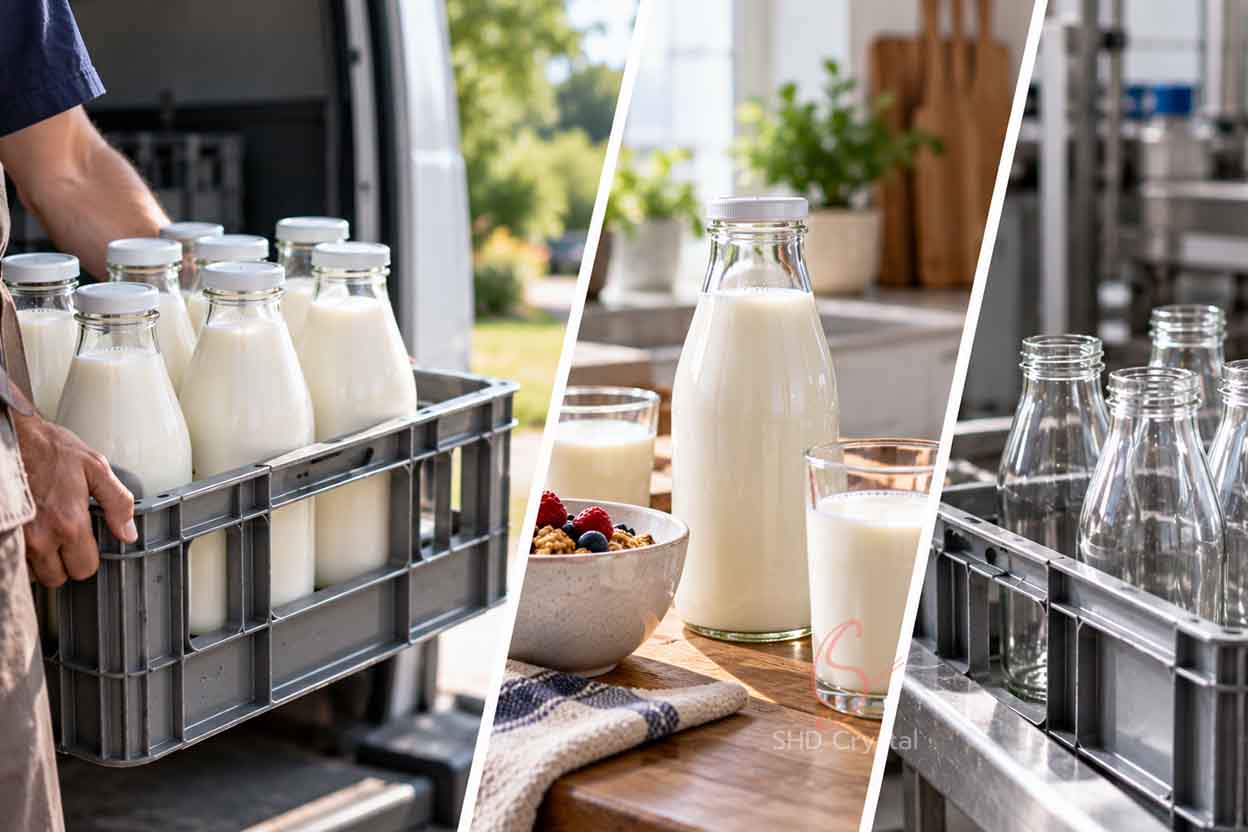
A prominent U.S. dairy company provides an excellent practical example. They implemented a deposit-based glass bottle recycling program that allows customers to return empty bottles to participating retail stores. These bottles are then transported back to the dairy plant for cleaning and reuse.
Such systems are particularly relevant to regional dairy operations because collection can potentially be coordinated with existing delivery routes. However, local distribution alone does not guarantee environmental benefits. Actual return rates, washing resources, bottle weight, and transport distances must also be considered.
Glass Milk Bottle Design Must Support Repeated Washing
A successful glass milk bottle design should be compatible with the intended industrial cleaning process. Smooth internal surfaces, accessible openings, and uncomplicated body geometry can help reduce areas where milk residue may accumulate. Narrow shoulders, decorative recesses, or difficult-to-clean details require additional evaluation.
Returnable bottles must also withstand their specified washing, filling, and handling conditions. The glass composition, structural design, annealing quality, and inspection criteria all contribute to performance. This does not mean that heavier glass always lasts longer. Excessive weight can increase transportation costs, while durability depends on the complete bottle structure.
For reusable dairy packaging, the objective is a bottle that remains functional through repeated handling without introducing unnecessary material or production complexity.
Closures, Labels, and Filling Equipment Must Work Together
The bottle is only one component of the packaging system. Neck dimensions must remain compatible with the selected filling and capping equipment. A consistent bottle opening helps maintain closure fit and reduces unnecessary adjustments during repeated production.
Labels also deserve attention. Permanent decoration may survive repeated washing differently from removable labels, so branding should be selected according to the cleaning and relabeling process. Closures require a separate decision. A reusable glass bottle does not automatically mean its cap can be reused. Food-contact suitability, sealing integrity, and sanitation requirements determine whether a closure is replaced during each filling cycle. These details make glass milk bottle design an engineering decision rather than a purely visual one.
Transportation Crates Are Part of the Product System
Returnable glass bottles need protection on both delivery and collection journeys. Reusable crates can keep bottles separated, reduce direct glass-to-glass contact, and simplify handling during loading, storage, and transportation. Their internal dimensions should match the bottle diameter and height. This creates a practical reason to standardize bottle proportions across a dairy product range.
Unnecessarily complex silhouettes can reduce packing efficiency or require specialized crate structures. For manufacturers, the relationship between bottle dimensions and transport equipment should be considered before final mold approval.
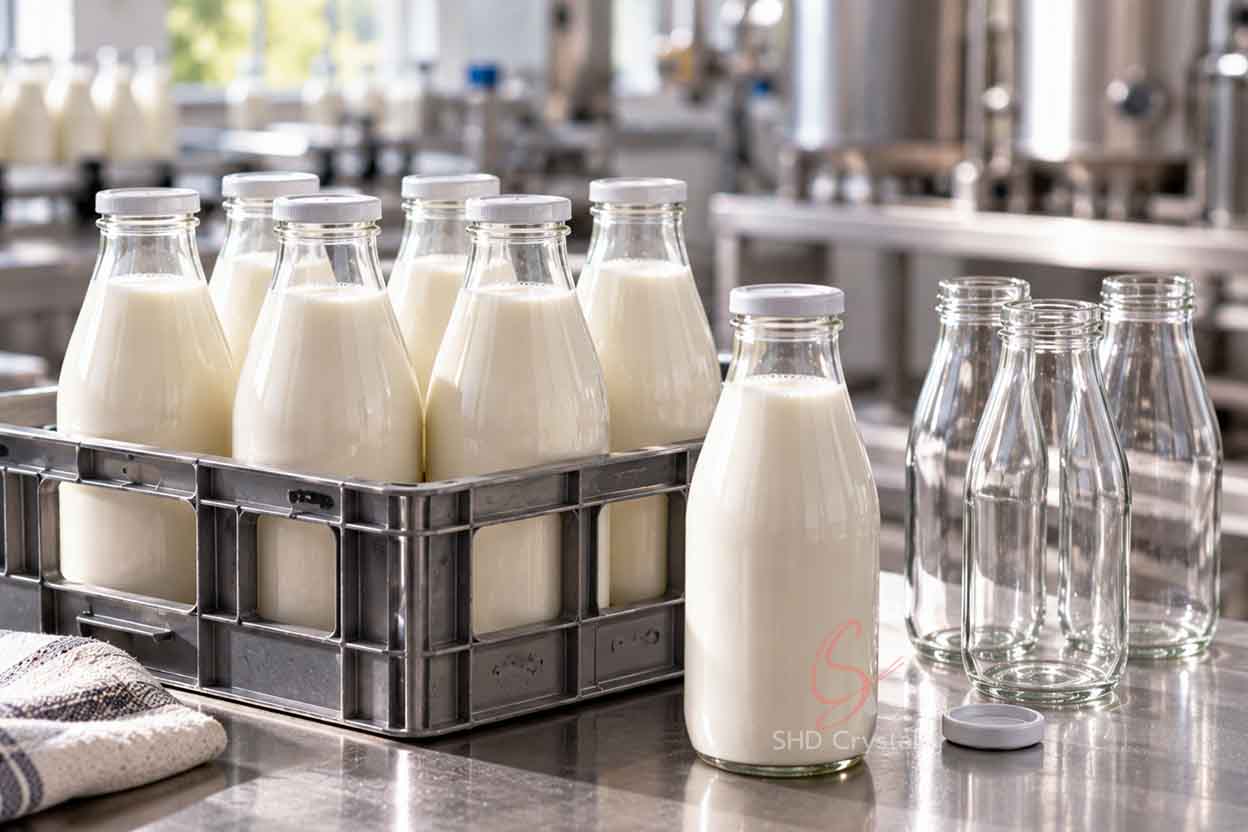
Consistency Matters More Across Multiple Journeys
A conventional bottle only needs to complete its intended initial distribution and use. A returnable bottle is expected to repeat that journey when it passes inspection. This makes dimensional consistency especially important.
Glass manufacturers need to control neck finish, body geometry, base stability, wall distribution, and annealing quality during initial production. Dairy operators must then apply appropriate cleaning and inspection procedures to determine whether returned bottles remain suitable for reuse. The two responsibilities are connected but distinct: manufacturing quality establishes the original bottle condition, while the return system determines whether each bottle can safely enter another filling cycle.
Conclusion
Returnable glass milk bottles can support regional dairy distribution when the packaging system is designed around collection, sanitation, refilling, and repeat transportation.
Effective reusable dairy packaging depends on more than selecting a durable material. A suitable glass milk bottle design must also accommodate cleaning equipment, closures, filling machinery, crate dimensions, and consistent quality standards. The strongest returnable packaging project is one in which the glass bottle and the operating system are developed together.
Developing Returnable Glass Milk Bottles With SHD Crystal
SHD Crystal provides glass manufacturing support covering mold development, automated bottle forming, annealing, surface finishing, quality inspection, and packaging preparation. For returnable glass milk bottles, project evaluation can begin with the required capacity, bottle dimensions, neck finish, glass distribution, and intended filling system. The design can also be reviewed against reusable crate dimensions, labeling requirements, and anticipated cleaning conditions.
SHD Crystal can support glass bottle development and production consistency, while dairy operators and packaging partners confirm the finished bottle’s suitability for their specific washing, sanitation, and reuse processes. This coordination helps brands develop glass milk bottle designs intended for integration into practical regional return-and-refill programs.
The link to this article is managed and owned by SHD Crystal. Please cite the source if reposting. Thank you for your cooperation.