
Working with a stubby bottle manufacturer is not simply a case of scaling down a standard tall bottle process. In our own production facility, we have repeatedly seen brands assume that a smaller form means a simpler job—but the physics of glass says otherwise. Short, squat profiles shift the center of gravity, disrupt heat distribution during forming, and introduce annealing challenges that barely register in taller designs. A reliable partner must control variables that are often neglected in conventional containers.
How a Stubby Bottle Manufacturer Handles Heat and Cooling
In any experienced stubby bottle manufacturer‘s shop, the first concern is forming temperature. A wide diameter combined with a short height makes the glass gob spread rapidly inside the mold. If the initial temperature is too high, the glass thins excessively near the shoulder, creating weak spots. Too low, and the material fails to fill the cavity completely, leaving a short shot. The optimal range narrows significantly—typically ±5 °C compared to ±10 °C for standard bottles. We monitor infrared sensors continuously and adjust the feeder speed to match gob weight with every cycle.
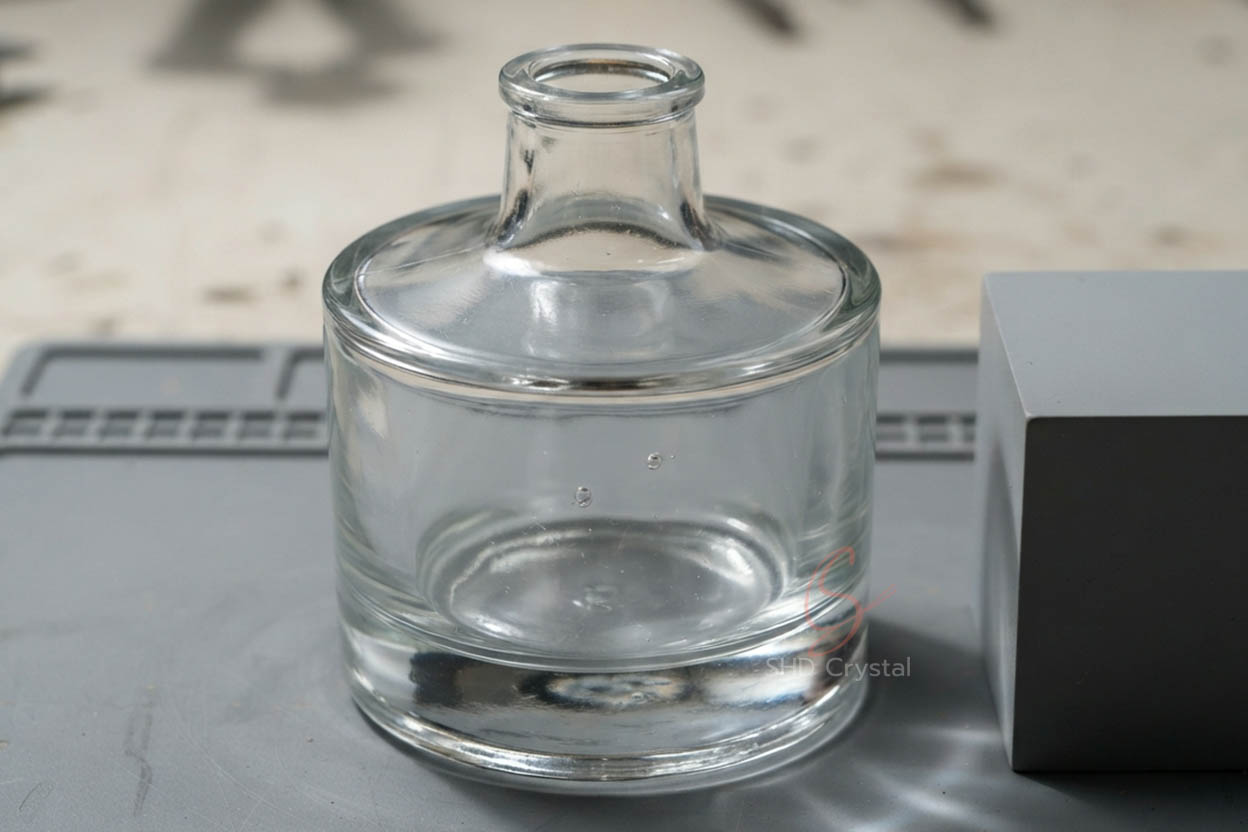
Cooling stress becomes another critical factor. A stubby design has a large surface area relative to volume, so the outer skin cools faster than the thicker base. This difference builds internal tension. During annealing, the stubby bottle manufacturer must extend the lehr cycle by 15–20% to allow gradual temperature equalization, a practice aligned with glass annealing guidelines. Rushing this step leads to spontaneous breakage during capping or transit. Our batch records consistently show controlled cooling rates of approximately 2 °C per minute through the strain point.
Mold tolerance, too, is far more visible on short bottles. A 0.05 mm misalignment on a 50 mm neck is much more noticeable than on a 100 mm neck, based on our in-line measurements. Flame polishing must be calibrated carefully to avoid rounding the crisp shoulder line. We often apply a cold-end coating to reduce friction and improve scratch resistance—an extra process step that buyers should factor into lead times.
Common Misconceptions About Compact Glass Packaging
Many buyers believe that compact glass packaging is inherently cheaper because it uses less raw material. In reality, the per-unit cost is often higher due to more frequent mold changes and slower cycle times. Short bottles require lower blow pressure to prevent distortion, extending the forming cycle by 2–3 seconds per cavity. Over a large run, this adds significant labor and energy costs. Another misconception is that any tall-bottle mold can simply be shortened. This ignores the drastic change in flow dynamics: glass does not move uniformly in a compressed cavity, and the resulting wall thickness distribution often proves uneven.
When sourcing compact glass packaging, evaluate the manufacturer’s experience with width-to-height ratios below 1.2. Such ratios demand specific baffle designs and neck ring configurations. Ask about rejection rates for similar geometries; a transparent supplier will quote around 5–8% for complex stubbies, compared to 2–3% for standard shapes. Achieving consistent wall distribution in compact glass packaging requires dedicated tooling and process knowledge.
Short Bottle Molding: Precision Meets Practicality
Short bottle molding is not just about reducing height—it means rethinking the blank and blow mold relationship. The blank mold often needs a larger diameter to accommodate gob spread, and the blow mold must have a steeper taper to release the finished bottle without sidewall scratches. The neck finish demands special attention because the short body offers less leverage for capping machines. Thread dimensions must be tighter to ensure proper seal compression, and we routinely verify them using profile projectors.

One practical limitation of short bottle molding is decoration. Screen printing on a curved, squat surface demands custom fixtures that hold the bottle at a precise angle. Hot-stamping foils may tear if the contour changes abruptly. In our experience, embossing or acid-etching is much more forgiving on low-profile shapes. We also advise on legibility: on a 60 mm diameter surface, 6 pt is typically the smallest readable text for clear glass, an important detail when planning short bottle molding projects.
From a buyer’s perspective, decision factors for a stubby bottle manufacturer should include available cavity count, sample lead time (usually 3–4 weeks for a first-off), and overrun policy. Because stubby bottles have higher dimensional variability, we recommend negotiating a 5% acceptable overrun to keep production on schedule.
Conclusion
Choosing the right stubby bottle manufacturer means accepting that compact forms amplify every manufacturing imperfection. By prioritizing controlled annealing, precise mold alignment, and realistic cycle planning, brands can turn a small bottle into a robust, eye-catching package that performs reliably on the filling line and survives shipping—without sacrificing the intended design impact.
Custom Stubby Bottle Production Tailored to Your Geometry
If you are searching for a stubby bottle manufacturer that treats short-height designs as a dedicated discipline rather than an afterthought, our team is ready to help. SHD Crystal offers in-house mold simulation, sample approval within 10 working days, and full annealing documentation per batch. From 50 ml travel sizes to 200 ml countertop pieces, we adjust forming parameters to your specific CAD geometry. Share your file for a feasibility report and cost breakdown—compact glass packaging can be just as refined when it is built with the right expertise.
Exclusive Release by SHD Crystal
Custom Crystal Glass OEM Manufacturer
This article is originally published by SHD Crystal. Original Link: https://shdcrystal.com/blogs/stubby-bottle-manufacturer/