
What to Ask a Trifle Bowl With Lid Manufacturer Before Sampling
Choosing a trifle bowl with lid manufacturer is more than picking the lowest quote; most buyers only realize that after their first bulk shipment arrives. A lidded dessert bowl looks deceptively simple, yet it carries the same production demands as fine drinkware: controlled wall thickness, clean rim finishing, and glass that survives from the lehr to the export carton. This guide walks through the decision points we weigh as a custom glass bowl supplier before any tooling is cut.
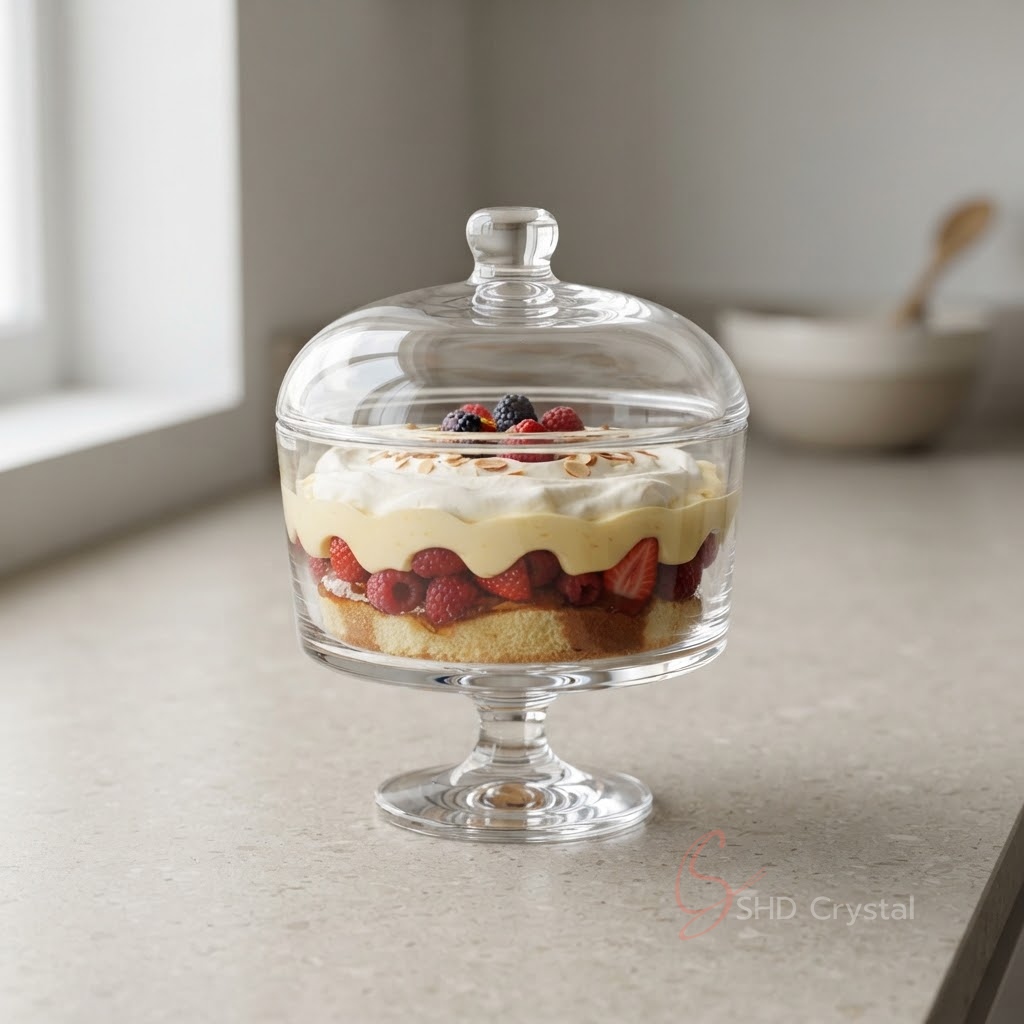
The sample can mislead you, so the questions matter more than the piece sitting on your desk. Focus on process and pairing rather than gloss, and you will avoid the two failure patterns we keep meeting on container ships: warped lids and cracked bases. That is the standard we hold every trifle bowl with lid manufacturer to.
The Lid Is Where Most Failures Begin
The hardest single part of any lidded bowl is the cover. We once worked with a buyer whose first lid run came back and the covers no longer seated on the bowl rim: the lid glass had been formed too thin and the annealing left each disc slightly banana-shaped, so a gap opened along one edge. That one line cost them a full repack abroad. When we run kitchen glassware OEM orders, we inspect lids in pairs against the actual bowl rather than against a separate tolerance chart.
Solid Turned Knob or Hollow Pull
The knob is a quiet fault line. A solid knob adds weight and is easy to grip; a hollow one is lighter but can leave an uneven strain pattern you only see under a polariscope. Ask whether the knob is solid or hollow, and confirm how the mold tolerance holds across the whole run. That one question tells a buyer a lot about a custom glass bowl supplier’s process discipline.
Service temperature matters more than most buyers assume. Lids and bowls expand at different rates when the glass thickness differs, so a dishwasher-safe claim should be verified against the strain point rather than taken on faith. Ask the stated thermal-shock tolerance and how the factory verifies it in the lehr.
Footed, Pedestal, or Footless Bowl Base
The base changes breakage risk more than appearance does, and it should be the first question in any kitchen glassware OEM review.
| Factor | Footed Bowl | Pedestal Bowl |
|---|---|---|
| Base stability | Widest footprint, steady on shelves | Raised center of gravity needs a thicker stem |
| Forming risk | Rim spinning is straightforward | Bowl-to-stem wall thickness transition is the weak point |
| Shipping cost | Lower breakage profile | Higher risk at the stem, needs dividers |
A far-too-common failure is a pedestal bowl that cracks clean at the bowl-to-stem junction during normal dishwashing. The wall thickness transition is too abrupt and residual stress from a hurried lehr cycle never fully releases. The sample looked perfect; the bulk order did not. From our production experience, we usually recommend putting pedestal wall thickness on the drawing instead of leaving it to the molder, and as a custom glass bowl supplier we adjust the lehr profile per geometry.
Side by side, a footless bowl packs and stacks the cheapest, a footed bowl gives the most stable footprint on a banquet table, and a pedestal version reads the most premium on a dessert display. For a trifle bowl with lid manufacturer, the base choice reshapes export packing cost as much as appearance, because each shape needs different carton protection and dividers.
Why Batch Consistency Beats the Perfect Sample
Stock-mold lids and bowls that match perfectly in the sample tray can drift apart run to run as molds wear and glass shrinkage shifts. We usually recommend ordering lids and bowls in the same production batch, and asking how the lid is matched to the bowl run — matched in pairs, or drawn from separate molds with no pairing. For a custom glass bowl supplier, batch consistency matters as much as sample quality, and it is the differentiator most buyers forget when they pick a trifle bowl with lid manufacturer.
In one recent lidded-bowl project, matching lids and bowls were struck from different molds with slightly different shrinkage, so we re-worked roughly three percent of the run before export packing. A practical consideration is that many kitchen glassware OEM buyers approve one pristine piece and never see the spread across the kiln.
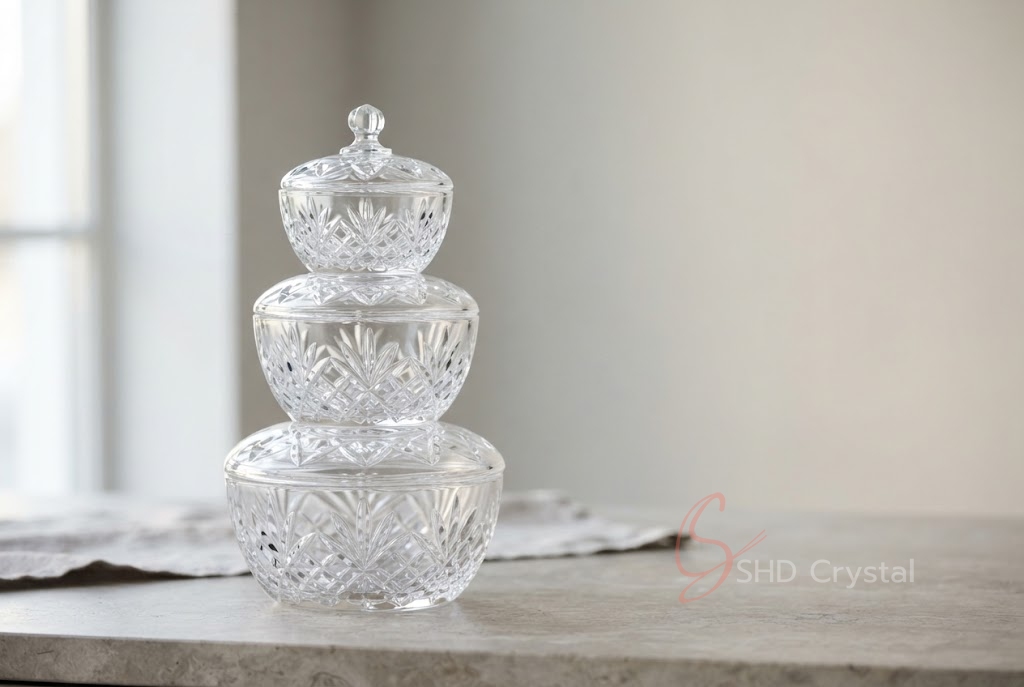
Check six to eight samples pulled from different positions in the lehr, and plan export packing at the same time you plan the product, using dividers so lids never touch bowl rims in transit.
Three Mistakes That Wreck Lidded Bowl Orders
Choosing by appearance only. A glossy sample ignores wall thickness, and thin walls crack on the first thermal cycle. Demand a cross-section drawing or a retained sample cut in half.
Skipping the pairing question. A buyer who never asks how the lid is matched to the bowl run ends up mixing lids and bowls from different molds, and nothing seats. Ask for matched sets from the trifle bowl with lid manufacturer and keep each set in the same carton.
Ignoring export packing. Lids that touch bowl rims in transit arrive chipped. Specify dividers and agree on carton protection before the mold is approved — a step too many kitchen glassware OEM buyers defer until the warehouse.
Frequently Asked Questions
Will a stock-mold lid match my bowl from an earlier order?
Ask how the lid is matched to the bowl run. Molds wear, so covers from a re-run may drift off the rim. We recommend pairing lids and bowls in the same production batch and keeping them together through export packing.
Is a dishwasher-safe claim on a lidded bowl reliable?
It depends on wall thickness and the strain point. Verify the stated thermal-shock tolerance and test one sample through an actual service cycle before approving bulk production.
How should lidded trifle bowls be packed?
Use carton protection with dividers so lids never touch bowl rims or stems. Plan the packing at the same time as the product, not as an afterthought at the warehouse.
Conclusion
Choosing a trifle bowl with lid manufacturer comes down to process discipline rather than the prettiest sample. Verify the lid pairing, the wall thickness transition, and the strain point, and you will avoid the warped lids and cracked pedestals we keep seeing come off the docks.
Starting a Custom Project With SHD Crystal
You do not need a finished design to begin; a rough sketch and a target quantity are enough for our team to advise on mold tolerance and export packing. If you are weighing a custom glass bowl supplier or a full kitchen glassware OEM program, we can review your trifle bowl with lid manufacturer requirements and walk you through the lehr and polariscope checks behind every retained sample.
Interested in custom glassware or related products?
Contact our team to discuss your project requirements.