
Why Trifle Bowl With Lid OEM Forces You to Think in Batch
Planning a trifle bowl with lid OEM project means juggling glass quality, lid fit, and export packing all at once, because a set is only as strong as its weakest seam. Buyers often assume a beautiful fired sample guarantees the whole order. In practice the disputes live in details a single sample could never show you. We build these sets for retail gift brands and hotel dessert programs, so we have watched the same gaps repeat.
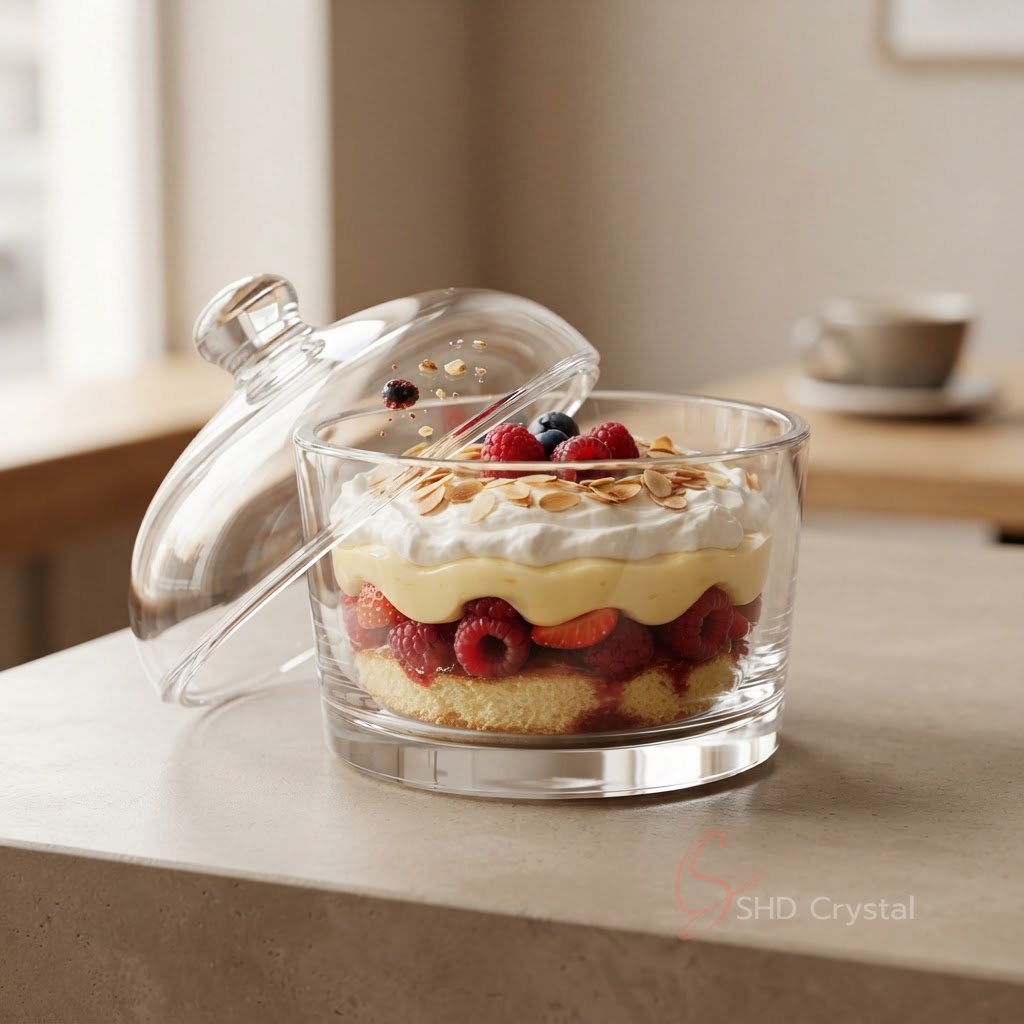
A single run of custom trifle bowl production can extend to thousands of pieces. When a buyer approves one hand-pulled sample, they are really approving the mold, the gather weight, and the lid seat, all of which drift slightly across a shift. Our lehr profiles are tuned per geometry, and we still measure rim finishing rather than eyeball it.
The Lid Seat Is the Whole Game
A trifle bowl is a two-part vessel: the bowl and the lid have to sit flush, or the set looks crooked on the shelf. That is where wall thickness transition at the rim decides whether lids seat cleanly. We once ran a decorated batch where fired enamel climbed onto the rim, covering it so the lid would not seal. We had to grind the rim back before shipping.
Batch to Batch, Not Just Sample to Sample
Stress hides in the wrong places too. A buyer approved a set from photographs, and the bulk lids still slotted in but never seated flush, because each run settled to a slightly different lip profile. Under a polariscope the retained samples showed perfectly even strain, yet the geometric drift between runs was the real problem. For a trifle bowl with lid OEM, batch consistency matters as much as the sample you signed off.
Stock Mold or Custom Mold for Your Set
The first fork in the road is whether you need a stock tool or a dedicated mold. The comparison below reflects what we see across gift and dessert programs, and it usually decides lead time and per-piece cost.
| Feature | Stock Mold | Custom Mold |
|---|---|---|
| Tooling cost | Little to none | Amortized per piece |
| Lead time | Weeks from catalog | Months while mold is dialed in |
| Lid-stock setup | Proven pairing | Needs repeat alignment |
| Batch to batch | Consistent | Depends on mold tolerance |
Casting a trifle bowl with lid OEM onto an existing stock mold collapses lead time, because the mold and lid pairing are already proven. Custom molds give you exact capacity and a lid seat engineered to your drawing, but they demand tighter mold tolerance and a higher minimum order to amortize the tooling. Either path is workable; the trade sits in lead time versus fit.
You essentially choose among three routes: a stock glass set that ships in weeks, a custom mold built to your dimension, or a hybrid where we adapt an existing bowl and machine a new lid. The stock route wins on price and speed, the custom route wins on fit and exclusivity, and the hybrid balances both. We usually recommend the hybrid for first-time trifle bowl with lid OEM buyers who want to test the market without a full tooling spend.
How to Vet a Dessert Glassware Manufacturer
Before you ask a dessert glassware manufacturer for pricing, pin down five inputs: set quantity, target capacity, decoration style, packing route, and lead time. Those shift which custom trifle bowl production route and which annealing profiles make sense. A serious factory talks about batch consistency and retention samples, not just a per-piece quote from a catalog stock item.
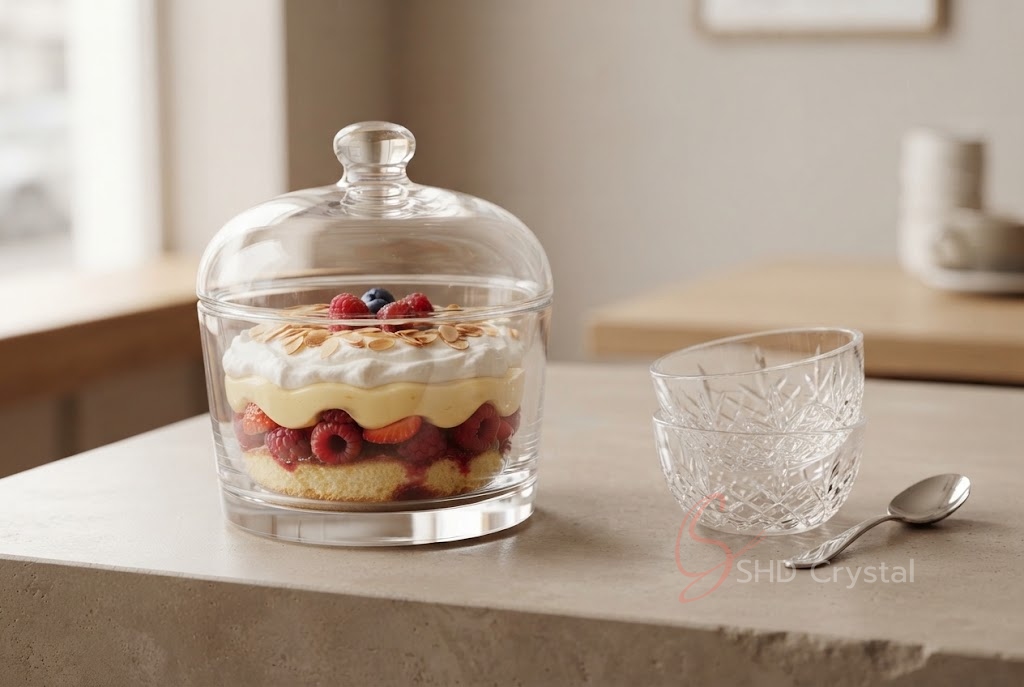
A hotel group we supply reordered the same set a second season. The first mold run seated perfectly; the second, cut from a reworked stock, needed the lid gap widened a millimeter before lids would settle. That micro-adjustment would be invisible from a photo alone, which is why we save and compare retention samples across custom trifle bowl production runs.
The Packing Question Buyers Skip
A trifle bowl with lid OEM set is a boxed gift, so the empty gap under the lid is a fragile feature you cannot pack like a plain bowl. We saw a gift brand’s heavy bowls slide inside the carton and compact the lids onto the rim lip, shorting the seating by the time the case arrived. That is the quiet failure no dessert glassware manufacturer advertises. Export packing had protected the glass but not the lid gap. Ask for a drop-test on the packed set and plan carton protection around the lid height.
A Practical Buyers Checklist
Give your supplier a concrete brief: define set quantities and request retention samples saved from each batch, ask whether you are on a stock mold or a custom mold before you finalize, and confirm lid-stock alignment holds across separate production runs. Depending on your volumes, custom trifle bowl production may be the only route that justifies a dedicated lid mold. And the fastest signal that you are dealing with a real dessert glassware manufacturer is a packing test they volunteer before you ask. Approve from multiple batch samples rather than one hero-buffed piece.
Frequently Asked Questions
What is the minimum order for a custom trifle bowl?
Stock mold programs can start at a few hundred pieces, while a dedicated custom mold usually asks for several thousand to amortize tooling. Confirm the gather weight and run size early, because they set the annealing and packing cost per unit.
Should we approve from a photo or a physical sample?
Always physical, and ideally from multiple pieces in the same batch. Photos hide rim finishing and lid seating, the two details that most often cause field complaints with lidded glass.
How do you ensure lids fit a subsequent production run?
We keep the lid and bowl on matched tooling, store a retention sample from each batch, and re-check the lid-stock geometry when a mold is re-cut. If we rework tooling, we widen the lid gap in controlled steps rather than relying on looks.
What packing do you recommend for a boxed gift set?
A drop-tested carton with the lid gap protected and heavier bowls braced so they cannot slide and compact the rims. Export packing for a lidded set needs more headroom than a plain bowl, because the lid adds fragile height.
Conclusion
A trifle bowl with lid OEM done well comes down to lid seating, batch consistency, and packing, not the polish on a single sample. Vet the process behind the glass, confirm lid alignment across batches, and you will ship a set people open twice.
Take the Next Step With a Factory That Builds Both Halves
At SHD Crystal, our team runs trifle bowl with lid OEM programs from mold drafting to export packing. Bring your set quantities and target capacities, and ask how we align lid-stock across batches and drop-test the packed gift box before it ships.
Interested in custom glassware or related products?
Contact our team to discuss your project requirements.