
Trophy Shaped Cologne Bottle OEM Starts With Stability
The trophy shaped cologne bottle OEM project looks flawless in the rendering, then the prototype tips over on the inspection bench. We say this because most sculptural glass fails on two things a design file cannot show you: center of gravity and wall thickness transition.
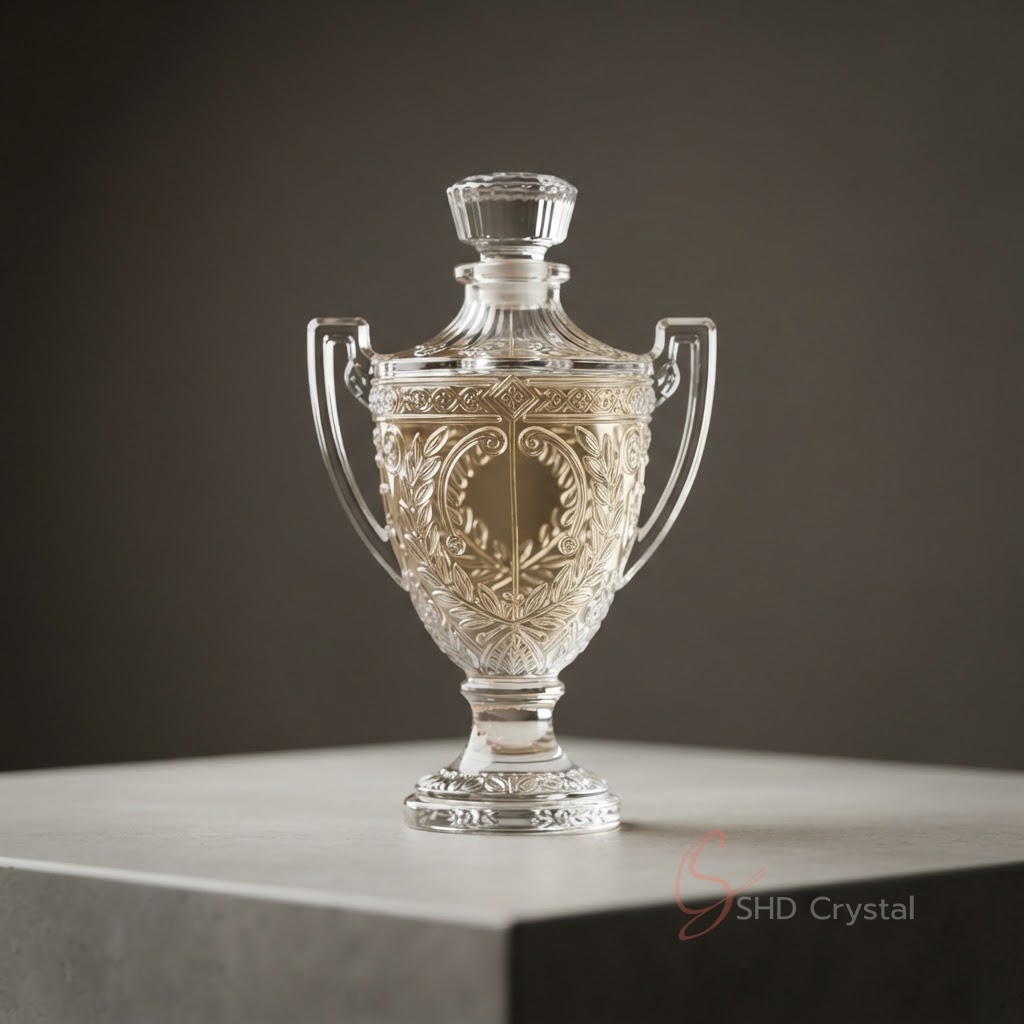
When a buyer brings us a sculptural fragrance flacon, the opening conversation is rarely about the trophy figure itself. It is about neck finish, base stability, and how the mold will release the raised relief without dragging the glass. In custom cologne bottle production the geometry is the brief; everything else follows from it.
A Simple Center of Gravity Test
Fit the cap, set the bottle on a flat surface, and nudge it. If it rocks before it settles, no amount of beautiful engraving will save it. We check center of gravity against base width on every sculptural piece and weigh the assembled unit exactly as the filler will fill it, never the empty glass alone.
| Decorative Section | Solid Crystal | Hollow Crystal |
|---|---|---|
| Weight balance | Mass sits above the neck finish | Lower center, easier base stability |
| Annealing | Thick mass needs a slower lehr | Even walls cool cleaner in the lehr |
| Internal sparkle | Dense crystal fire | Slightly muted but lighter to move |
| Mold tolerance | Simpler core construction | Complex pins, more mold tolerance needed |
In practice, we usually recommend hollow decorative sections above the neck for any trophy shaped cologne bottle OEM. A fully solid figure adds appreciated weight, but it raises the tipping risk and forces a wider base than most buyers want. On the hollow route, the wall thickness transition is far easier to control at the strain point.
From our production experience, buyers who insist on a heavier oxide-laden crystal over a lighter soda-lime body usually do so for perceived value, yet the extra grams must be balanced before the mold is cut. That decision belongs in custom cologne bottle production scoping, not after the sample has been approved.
Two Failure Modes We Keep Seeing
We once made a trophy-shaped bottle for a gift brand with a heavy sculpted lid. The approved sample stood fine, but in bulk a slightly heavier glass gathering shifted the center of gravity and the bottle toppled off retail shelves. The lesson was base stability: match the footprint to the assembled weight, including the cap and the perfume it holds.
We have also watched raised relief in a mold distort a cologne brand’s fine-line logo at the curvature; the font closed up because the flat artwork was never re-mapped over the shoulder. For novelty perfume packaging we ask for vector files early so the layout curves to the neck before the mold steel is cut to tolerance.
Decorating a Trophy: Three Honest Routes
For the trophy surface there are three honest routes. Engraved cutting leaves a crisp fine line that reads as luxury; sandblasting delivers an even matte across the relief; and screen printing bends around the tightest curve of a trophy shaped cologne bottle OEM design. Each suits a different brief: engraving for a dated award, sandblast for a museum matte, and print for a seasonal slogan. Most sculptural ranges combine at least two.
Five Questions to Raise With Your Supplier
Before you commit to a custom cologne bottle production run, ask the factory by name: What is the center of gravity relative to base width for a trophy shaped cologne bottle OEM? Are the decorative sections solid or hollow? How does the lehr account for thick and thin sections in one piece? How will the relief and fine print behave over the curve? And what is the shelf stability and interlock when bottles stand nested during filling? A supplier that answers these directly, instead of with a stock line, is worth a trial.
A Short Micro-Scenario
Last season a hotel buyer handed us a single 2D sketch of a golf trophy and a firm deadline. We milled a machined mock, held three mold iterations on the figure, and shipped the first validated build inside eight weeks. It became their annual prize.
Sample Beauty Is Not Batch Stability
The most common buyer mistake is approving one especially refined piece. In custom cologne bottle production, batch consistency decides a gift order, so we check a polariscope reading and rim finish across six samples from the same run rather than the single showpiece.
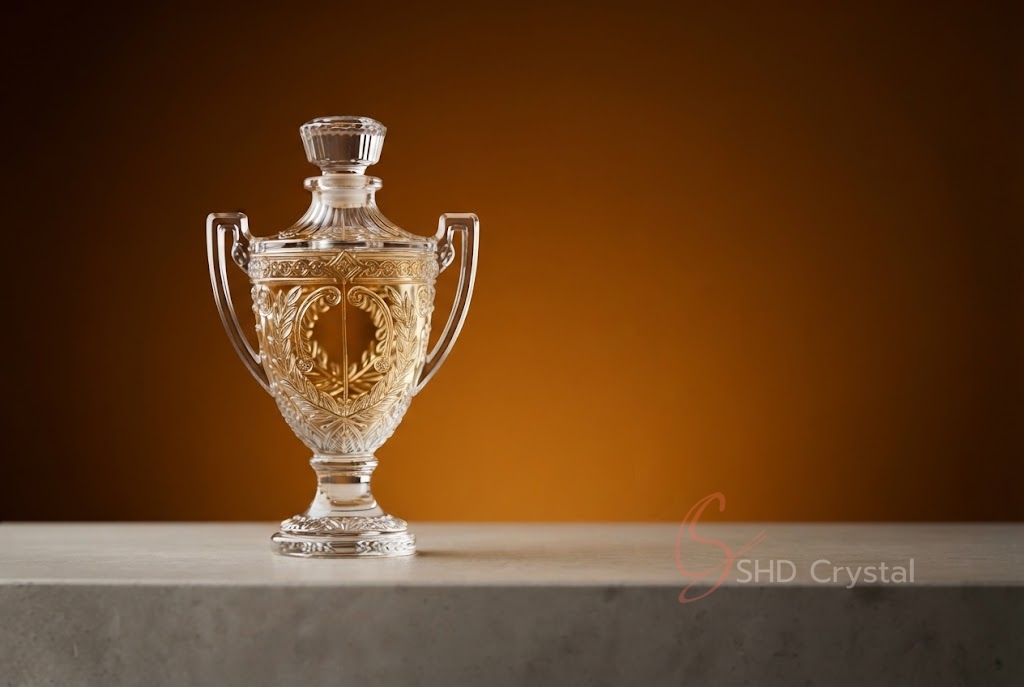
We also segment novelty perfume packaging by mold and by run so a souvenir edition can roll out without re-qualifying the whole line. Dimensional tolerance matters more here than in a round press, so the inspection plan is set early.
Packaging Intelligence and Range Thinking
A narrow-base sculpture is only as safe as its carton. We use shaped inserts and neck risers so the glass never travels shoulder-to-shoulder, and we fold novelty perfume packaging trials into the same schedule as trophy shaped cologne bottle OEM so breakage risk is designed out, not hoped away.
For hotel gift programs and corporate awards, novelty perfume packaging is what turns a one-bottle order into a collection. Buyers often pair a trophy silhouette with a matching travel spray so the range carries visually across a suite.
Frequently Asked Questions
Why does a trophy-shaped bottle tip over when the sample stood fine?
Usually because the base width was matched to the empty glass, not the assembled unit. Once the cap and fill are added, the center of gravity rises and the balance shifts. Confirm the base against the full capped and filled weight during sampling.
Are solid decorative sections always better for a trophy?
No. Solid mass above the neck finish looks premium but raises tipping risk and slows annealing. Hollow sections are lighter, easier to balance, and cool more evenly through the lehr. Let the base width and wall thickness transition decide, not the render.
How do we keep the cologne logo from distorting over the curve?
Supply the fine-line artwork early so we can re-map it over the neck and shoulder before the mold steel is cut. Relief in the mold and the surface curvature both pull fine print, so the flat layout is never used as-is.
What is a realistic lead time for a sculptural mold?
A trophy silhouette with raised relief typically needs a machined mock and one to three mold iterations. Plan eight to ten weeks for the first validated build, then a separate schedule for batch validation and carton protection.
Conclusion
Whatever silhouette you choose, a trophy shaped cologne bottle OEM that cannot stand has no shelf life. Nail the center of gravity, balance the decorative mass, and anneal the thick and thin sections together, and the sculpture sells itself.
Planning Your First Sculptural Run
If you are weighing a trophy shaped cologne bottle OEM project, tell us the silhouette and the imagined weight. At SHD Crystal we map the artwork, the lehr profile, and the carton protection before cutting a single mold, so the first validated build stands and ships as intended.
Interested in custom glassware or related products?
Contact our team to discuss your project requirements.